

The Hidden Connection Between Home Heating Systems and Persistent Household Odors
Estimated Reading Time: 7 Minutes
Executive Brief
When heating systems begin operating during cooler weather, homeowners may notice odors that were previously faint or undetectable. Although accumulated dust and HVAC maintenance issues can produce unpleasant smells, heating systems can also redistribute odors originating from pet contamination, smoke residue, moisture-affected materials, and concealed building spaces.
Temperature, humidity, airflow, and pressure differences influence how odor-producing compounds move through a home. Understanding these relationships helps distinguish mechanical problems from persistent household contamination. Rather than repeatedly treating the air, effective odor management begins by identifying the source, determining how the odor travels, and selecting an appropriate corrective action.
Key Takeaways
- Heating systems can reveal existing odor problems. An unpleasant smell near a vent does not necessarily originate inside the HVAC equipment.
- Air movement matters as much as temperature. Forced-air circulation and pressure differences can transport odors between rooms and concealed spaces.
- Some odors originate beneath visible surfaces. Pet urine, smoke residue, and moisture-related contamination can remain in materials long after surface cleaning.
- The correct solution depends on the source. HVAC maintenance, moisture correction, and professional odor remediation address different problems.
The first chilly morning arrives in Charlotte, and you turn on the heat. Within minutes, an unfamiliar odor begins moving through the house.
Perhaps it smells dusty, musty, or faintly smoky. Maybe an old pet odor has returned despite months of cleaning. Whatever the smell, its timing raises an obvious question: Why does the house smell different when the heat comes on?
The answer is not always found inside the furnace.
Heating systems influence the movement of indoor air, potentially making existing odors more noticeable. Understanding the relationship between household contamination, temperature, and airflow is the first step toward determining whether the problem requires HVAC maintenance or professional odor removal.
Why Household Odors Become More Noticeable During Heating Season
Indoor air is constantly interacting with building materials, furnishings, temperature, and moisture.
Some materials absorb or retain odor-producing substances and release them gradually. Others contain contamination beneath their visible surfaces.
When a forced-air heating system operates, it pulls air through return registers, conditions that air, and distributes it through supply ducts. This circulation can carry odor compounds from one area into another.
Temperature changes may also influence how readily certain volatile compounds move from materials into the surrounding air.
These processes are related but distinct:
- Odor release: Compounds move from a contaminated material into indoor air.
- Odor transport: Air circulation carries those compounds through the building.
- Odor perception: Concentration, environmental conditions, and individual sensitivity affect how strongly an odor is noticed.
The U.S. Environmental Protection Agency's indoor air quality guidance identifies temperature, moisture, building materials, and HVAC operation among the factors influencing indoor air conditions.
This explains why a smell may become noticeable during heating season without necessarily indicating new contamination.
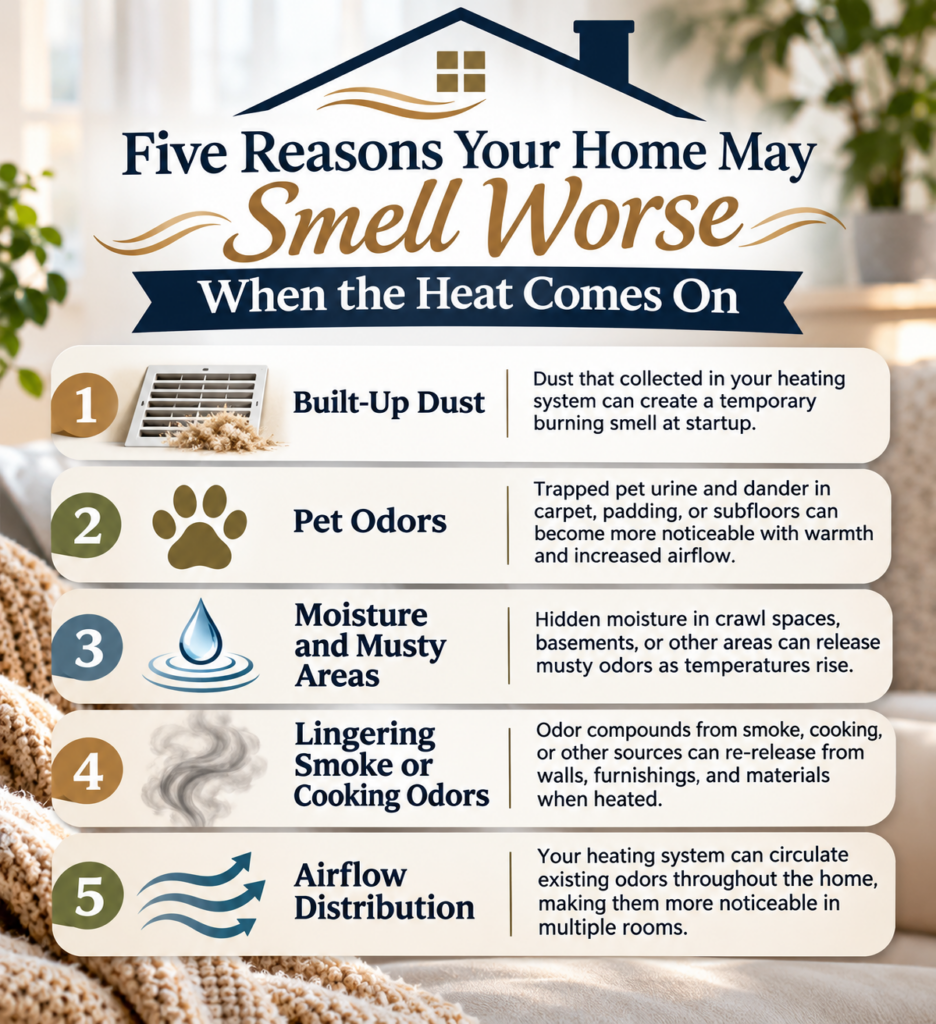
Five Reasons Your Home May Smell Worse When the Heat Comes On
1. Dust Accumulation Inside Heating Equipment
During warmer months, dust can settle on components that remain relatively inactive until heating season begins.
When these components warm up, accumulated dust may produce a temporary burning or dusty smell.
According to Carrier's guidance on furnace odors, this seasonal odor commonly dissipates within approximately 30 minutes to a few hours.
However, persistent burning smells, electrical odors, or the smell of melting plastic should not be treated as ordinary dust accumulation.
What homeowners should know: A temporary dusty smell may be normal during initial startup. An odor that becomes stronger, repeatedly returns, or suggests overheating warrants professional HVAC inspection.
2. Pet Urine Contamination Beneath Flooring
Pet urine is particularly difficult to address when contamination extends beyond the visible carpet surface.
Liquid can penetrate carpet backing, padding, wood subfloors, and seams between flooring materials.
Even when the surface looks clean, residual contamination may continue producing unpleasant odors.
Changes in moisture and temperature can affect odor release, while heating-system circulation can distribute those odors throughout nearby rooms.
This creates an important distinction: the heating system may make the problem noticeable, but the source remains within the flooring materials.
Homeowners dealing with recurring contamination should consider whether previous cleaning reached the affected padding or subfloor. In our article Replace Carpet After Pet Urine? | Carolina Odor Pros we examine exactly how this happens and what to look for.
Carolina OdorPros offers professional odor removal services for persistent household contamination, including pet-related odors.
3. Moisture-Related Odors From Concealed Spaces
Crawl spaces, basements, wall cavities, and other enclosed areas can develop moisture problems that contribute to musty odors.
In Charlotte's humid climate, moisture management is especially relevant when evaluating these conditions.
Water intrusion, condensation, damp insulation, and moisture-affected building materials may create environments where microbial growth occurs.
When heating systems change airflow or pressure relationships, odors from concealed spaces may become more noticeable inside occupied rooms.
The EPA recommends controlling indoor moisture and maintaining relative humidity below 60%, ideally between 30% and 50%.
A persistent musty smell should prompt investigation of moisture conditions rather than immediate assumptions about a particular contaminant. In our article 10 Signs Hidden Mold Is Growing Behind Your Walls | Carolina Odor Pros we talk about the 10 signs that you have a hidden mold problem. Knowing the difference between just a regular water problem and mold damage is important in defining moisture related odor problems.
Important distinction: An odor assessment can help investigate odor sources, but suspected mold growth or structural moisture damage may require qualified inspection and specialized corrective work.
4. Lingering Smoke and Cooking Residue
Smoke and cooking odors can remain in a home after the original activity has ended.
Odor-producing compounds may accumulate on walls, ceilings, cabinets, upholstery, and other interior surfaces.
Some of these compounds can subsequently return to indoor air through processes influenced by temperature, ventilation, and material properties.
Heating-season airflow may make these lingering odors more noticeable, particularly in homes with previous cigarette smoke exposure or repeated heavy cooking.
A familiar smell returning does not necessarily indicate a new source. It may reflect residual contamination that was never fully addressed.
Carolina OdorPros' odor removal services include solutions for persistent smoke and other household odors.
In our article Why Does My House Smell Musty Even When It’s Clean? talks about residual smells caused by left over debris and how to address them properly.
5. Airflow Changes That Redistribute Existing Odors
Airflow is often overlooked during household odor investigations.
Forced-air systems create pressure differences as air moves through return ducts, supply ducts, and occupied spaces.
When ductwork leaks or building openings allow unintended air movement, odors can migrate from crawl spaces, attics, garages, or other areas.
The smell may be strongest near a vent even though its source is located elsewhere.
This is why identifying an odor's location is not always the same as identifying its origin.
A thorough investigation considers both the contaminated material and the pathway allowing the odor to reach occupied rooms.
What Different Heating-Season Odors May Indicate
| Odor characteristic | Possible explanation | Appropriate response |
|---|---|---|
| Brief dusty smell | Dust on heating components | Monitor during seasonal startup |
| Persistent burning or electrical odor | Overheating or equipment malfunction | Stop using the equipment if safe and contact an HVAC technician |
| Musty or damp smell | Moisture-affected materials or HVAC components | Investigate moisture and arrange appropriate inspection |
| Pet urine odor | Residual contamination in flooring or furnishings | Evaluate affected materials |
| Stale smoke odor | Residue on interior surfaces | Assess contamination and cleaning requirements |
| Rotten egg or sulfur odor | Possible natural gas leak | Evacuate immediately and contact the gas utility or emergency services from outside |
Safety note: Carbon monoxide cannot be identified by smell. Maintain functioning carbon monoxide alarms and have fuel-burning equipment inspected according to manufacturer and professional recommendations. If a carbon monoxide alarm activates, evacuate and contact emergency services.
How to Determine Whether the Heating System Is Responsible
An effective investigation begins with understanding the relationship between the odor and the heating cycle.
Consider these observations:
Timing: Does the smell appear only during the first heating cycle of the season, or does it return every time the equipment operates?
Location: Is the odor strongest near one supply register, throughout the house, or in a particular room?
Air circulation: Does the smell also occur when the HVAC fan operates without heating? This may suggest that air movement contributes to odor distribution.
Property history: Have there been previous pet accidents, water leaks, smoke exposure, or recurring moisture problems?
Recent changes: Has the property undergone flooring replacement, ductwork modifications, renovations, or changes in ventilation?
These observations can help professionals distinguish a heating-equipment problem from an odor originating elsewhere.
They are diagnostic clues—not proof of a particular cause.
For suspected combustion, electrical, or gas-related hazards, do not deliberately operate the equipment to investigate the smell.
Should You Have Your Air Ducts Cleaned?
Duct cleaning is sometimes recommended when homeowners experience persistent odors, but it is not a universal solution.
The EPA's guidance on residential duct cleaning explains that routine duct cleaning has not been demonstrated to prevent health problems and should be considered in relation to specific conditions.
If contaminated ductwork is contributing to the odor, professional cleaning may be appropriate.
However, duct cleaning cannot eliminate pet urine beneath carpeting or smoke residue embedded in furnishings.
The key question is whether the ductwork contains the odor source or is simply transporting contaminated air.
Why Air Filters and Fragrance Products Have Limitations
Replacing an HVAC filter is an important maintenance practice, but filters are not designed to resolve every household odor problem.
Most residential HVAC filters primarily capture airborne particles. Certain specialized filtration technologies can reduce some gaseous contaminants, but their effectiveness depends on the pollutants involved and the filtration system. Even in our article about Why Does My House Smell Worse When the Air Conditioner Turns On? it discusses that HVAC ventilation systems just transfer air throughout the house and unfortunately become the transportation mechanism for odor causing microbes.
The EPA's guide to air cleaners and filters explains that filtration can supplement source control and ventilation but cannot remove every indoor pollutant.
Similarly, fragrance products may temporarily change how a room smells without eliminating contamination.
If pet urine remains beneath flooring or smoke residue remains on interior surfaces, treating the circulating air alone will not remove those materials.
The most effective strategy generally begins with identifying and controlling the source.
When Professional Odor Assessment Becomes Appropriate
Not every seasonal heating odor requires specialized remediation.
A temporary dusty smell may resolve after initial equipment operation. Mechanical and combustion-related concerns should be directed to qualified HVAC professionals.
However, a professional odor assessment becomes more relevant when:
- Persistent odors return despite ordinary cleaning.
- The smell appears connected to previous pet accidents or smoke exposure.
- Odors are detected in multiple rooms without an obvious source.
- Contamination may extend beneath flooring or into porous materials.
- Previous attempts to eliminate the odor have produced only temporary results.
An appropriate assessment helps determine whether the problem involves contaminated materials, environmental conditions, or another source requiring specialized attention.
Carolina OdorPros serves homeowners and businesses throughout Charlotte and surrounding communities, providing professional odor removal solutions for a variety of persistent odor concerns.
Frequently Asked Questions
Can changes in indoor air pressure cause odors from crawl spaces or attics to enter living areas?
Yes. Pressure differences created by HVAC equipment, exhaust fans, and building leakage can influence how air moves between different parts of a home. Leaking return ducts or openings around plumbing and structural penetrations may allow air from concealed spaces to enter occupied rooms. HVAC pressure and leakage testing can help determine whether these pathways contribute to recurring odors.
Why might an odor be strongest in a room where no contamination is visible?
Odor concentration depends on both the source and the movement of air. A room may receive contaminated air from another area through ductwork, open doorways, or building cavities. Differences in ventilation and air exchange can also allow odors to accumulate in particular locations. This is why identifying the strongest-smelling room does not always identify the source.
Can residual pet urine remain beneath flooring even when the surface appears completely clean?
Yes. Carpet cleaning can remove visible staining while leaving contamination in padding, wood, or other porous materials. The extent of penetration, flooring construction, and previous cleaning methods influence whether targeted treatment or material replacement is necessary. Evaluating the underlying materials is often more informative than repeatedly cleaning the visible surface.
Can seasonal changes make an existing odor more noticeable without the underlying contamination becoming worse?
Yes. Temperature, humidity, ventilation, and airflow can affect the release and distribution of odor-producing compounds. A previously existing source may become more noticeable under different environmental conditions. However, odor intensity alone cannot establish whether contamination is stable, increasing, or decreasing. The underlying conditions still require evaluation.
When should a homeowner seek both HVAC evaluation and professional odor assessment?
Both may be appropriate when an odor consistently appears during HVAC operation but evidence also suggests contamination outside the equipment. An HVAC technician can evaluate mechanical operation, duct leakage, and ventilation conditions. An odor-remediation specialist can investigate suspected contamination in flooring, furnishings, and other materials. Coordinating these findings may prevent unnecessary treatments and repeated expenses.
A Heating System May Reveal the Problem Without Being Its Source
When an unpleasant odor returns every time the heat comes on, replacing filters or applying fragrance may provide little lasting improvement if the source remains elsewhere.
Understanding how odors originate, enter indoor air, and move throughout a home makes it possible to select a more appropriate solution.
For homeowners in Charlotte and surrounding communities, persistent pet, smoke, and other household odors deserve an investigation focused on the underlying cause—not another temporary cover-up.
Schedule an Odor Assessment With Carolina OdorPros
Find the source. Understand the problem. Take the next step toward a fresher home.
If persistent household odors continue returning despite ordinary cleaning, Carolina OdorPros can help investigate potential sources and discuss appropriate remediation options.


Research References
- U.S. Environmental Protection Agency — The Inside Story: A Guide to Indoor Air Quality
- U.S. Environmental Protection Agency — Carbon Monoxide's Impact on Indoor Air Quality
- Carrier — Burning Smell in House? Causes and Solutions for Furnace Odors