

Should You Replace Carpet After Pet Urine—or Can It Be Remediated?
Carolina Odor Pros | October 12, 2026 | Homeowner Decision Guide
Estimated Read Time: 9–11 minutes
The carpet smells like pet urine. You've cleaned it, treated the stain, and maybe even rented a carpet-cleaning machine. But days later, the odor returns. Now you're facing a frustrating and potentially expensive decision: Should you replace the carpet entirely, or is there a way to save it?
For homeowners throughout Charlotte, North Carolina, and surrounding communities, pet urine contamination is a common household challenge. Unfortunately, replacing the carpet doesn't always eliminate the problem, particularly when urine has penetrated the padding or reached the subfloor.
The good news? Not every urine-affected carpet needs to be discarded. The right solution depends on how deeply the contamination has traveled, how long it has been present, and whether the affected materials can be effectively treated.
Understanding the difference between carpet cleaning, professional odor remediation, and carpet replacement can help homeowners make a more informed decision without spending money on unnecessary repairs.
Executive Brief
Pet urine contamination does not automatically mean carpeting must be replaced. Some carpets can be successfully treated when contamination is limited and the affected materials remain accessible. However, repeated accidents, saturated padding, and urine-damaged subflooring can make replacement or targeted material removal necessary.
The most important step is identifying the full extent of contamination before deciding whether to clean, remediate, or replace the flooring.
Key Takeaways
-
Carpet replacement isn't always necessary. Some pet urine odors can be successfully remediated.
-
The carpet surface tells only part of the story. Urine can penetrate backing, padding, and subflooring.
-
Repeated contamination increases the difficulty of remediation. Multiple accidents in the same location may affect several flooring layers.
-
New carpeting doesn't guarantee odor elimination. Untreated contamination beneath the carpet can continue producing odors.
-
Professional odor assessment helps prevent unnecessary expenses. Understanding the source is the first step toward choosing the right treatment.
What Actually Happens When Pet Urine Soaks Into Carpet?
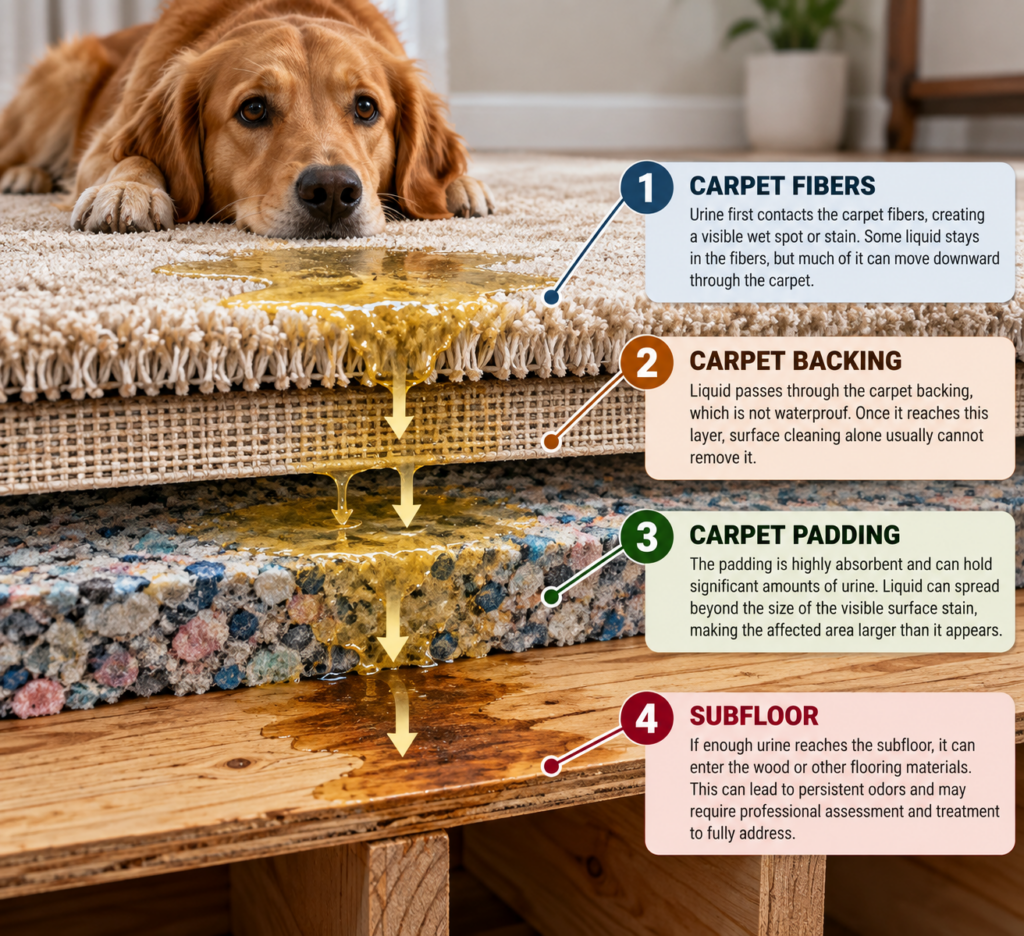
When a pet urinates on carpet, the liquid rarely stays confined to the visible stain.
Carpeting consists of multiple layers, each with different absorption characteristics. Depending on the volume of urine, carpet construction, and how quickly the accident is discovered, contamination may penetrate beyond the surface.
Pet urine can move through several flooring layers, making the visible carpet stain an unreliable indicator of the full extent of contamination.
Also Read 🐈Pet Urine in Carpet & Subfloor: What Really Happens? | Carolina OdorPros
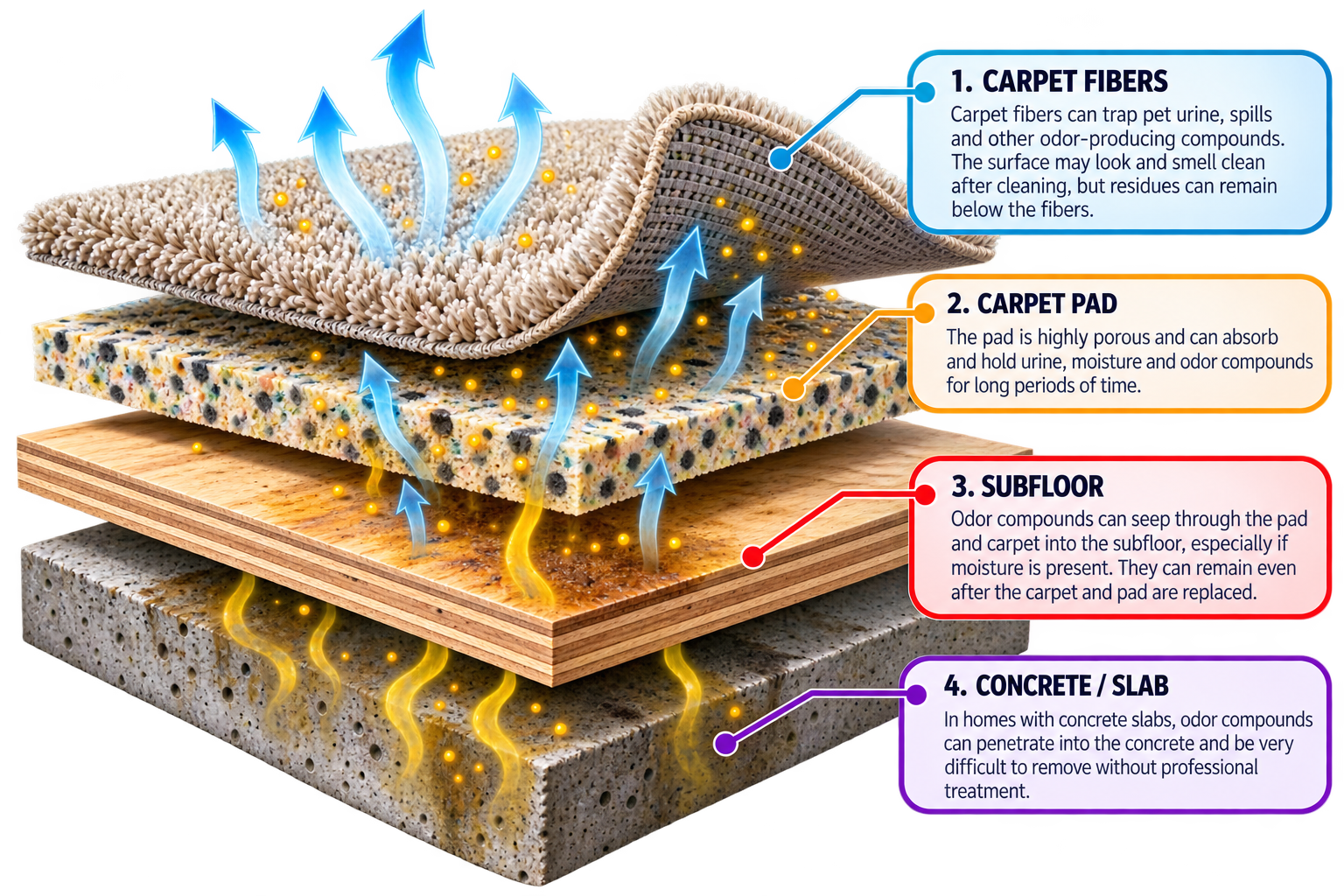
The Four Layers of Pet Urine Contamination
Layer 1: Carpet Fibers
The visible portion of the carpet absorbs urine and may develop staining and odors. Prompt attention can sometimes prevent deeper penetration, but surface cleaning alone may not reach the entire affected area.
Layer 2: Carpet Backing
Urine can penetrate the backing that holds carpet fibers together. Once contamination reaches this layer, ordinary surface cleaning becomes less reliable.
Layer 3: Carpet Padding
Carpet padding can absorb and retain substantial amounts of liquid. Depending on the material and extent of saturation, contaminated padding may require replacement even when the carpet itself can be preserved.
Layer 4: Subflooring
When urine reaches plywood, oriented strand board (OSB), or other porous subfloor materials, it can become trapped beneath the carpet.
This is particularly concerning because homeowners may replace the carpet and padding without realizing the subfloor remains contaminated.
Also Read 🐈Cat Urine Odor Removal: Why the Smell Is So Hard to Remove
When Can Pet Urine Odors Be Remediated Without Replacing Carpet?
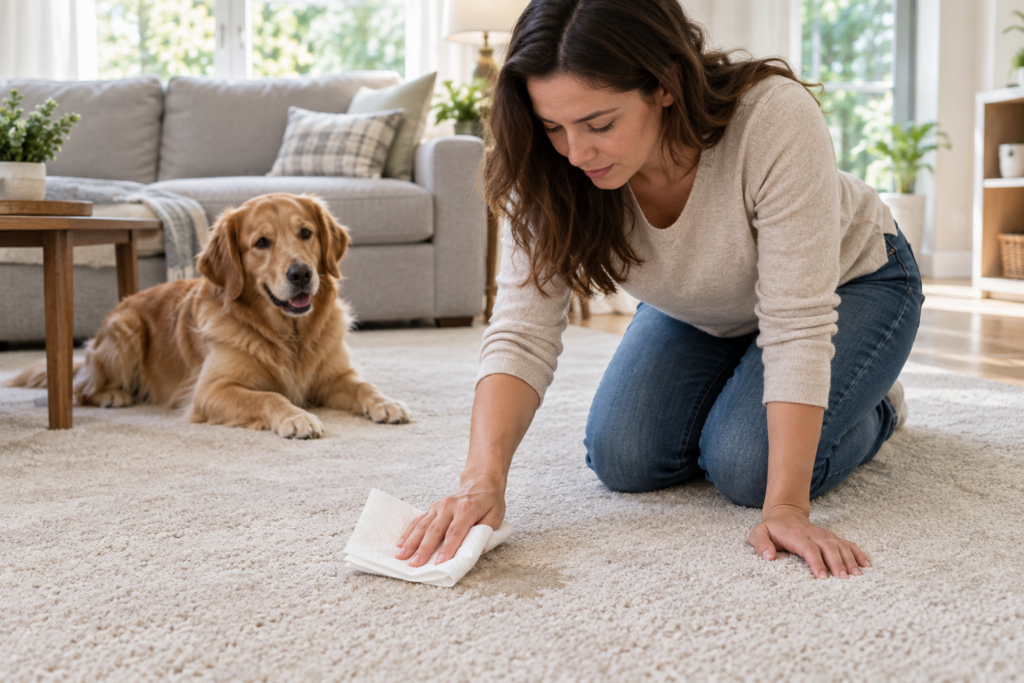
The possibility of saving a carpet depends on several factors, including the amount of urine, the age of the contamination, the carpet's condition, and how deeply the urine has penetrated.
Situations Where Remediation May Be Successful
Recent, isolated accidents
When a pet has a single accident and the urine is addressed quickly, contamination may be limited enough for targeted treatment.
Carpet fibers and backing remain structurally sound
If the carpet is not deteriorating, delaminating, or permanently damaged, it may be possible to preserve the material.
Contamination is limited to accessible areas
Localized contamination is generally easier to address than widespread saturation affecting an entire room.
Padding and subflooring are not extensively affected
When the underlying materials are clean or can be treated appropriately, there may be no reason to replace the entire floor covering.
Odor sources can be identified and reached
Successful remediation requires more than reducing the smell temporarily. The treatment must address the materials responsible for producing the odor.
Also Read🐈Pet Urine Odor Removal in the Carolinas | Carolina Odor Pros
Why Professional Odor Remediation Is Different From Ordinary Carpet Cleaning
Traditional carpet cleaning primarily focuses on removing visible soil, stains, and some contaminants from carpet fibers.
Professional odor remediation focuses on identifying and addressing the underlying sources of persistent odors.
Depending on the circumstances, this may involve targeted cleaning, specialized odor treatments, assessment of underlying flooring materials, and recommendations for replacing components that cannot be adequately restored.
However, no treatment method can guarantee success in every situation. The extent and accessibility of contamination ultimately determine what can be saved.
When Is Carpet Replacement the Better Option?
There are situations where replacement is the more practical and economical decision.
Persistent odors may originate in carpet padding or subflooring, even when the visible carpet appears relatively clean.
Repeated Urination in the Same Location
Pets frequently return to previously soiled areas, especially when residual odors remain detectable.
Repeated accidents can introduce additional moisture and urine residues into the same flooring materials, increasing the likelihood of deeper contamination.
Widespread Saturation
When large portions of a carpet and its padding have been repeatedly saturated, localized treatment may no longer be practical.
Extensive contamination can make replacement more economical than repeated cleaning attempts.
Deteriorated Carpet or Padding
Urine contamination combined with age, moisture exposure, and repeated cleaning may contribute to material deterioration.
Carpeting with damaged backing, severe staining, or structural problems may not be worth preserving.
Contaminated Materials Cannot Be Effectively Accessed
If urine has penetrated inaccessible flooring layers, it may be necessary to remove carpet or padding to reach the source.
In some cases, the carpet can be temporarily lifted and reinstalled. In others, replacement is more practical.
Previous Treatments Have Failed
If multiple properly performed cleaning attempts have failed, a more comprehensive evaluation is warranted.
That doesn't necessarily mean the carpet must be replaced. It may mean the underlying source was never addressed.
Also Read 🐈Why Does My House Smell Musty Even When It’s Clean?
Carpet Replacement vs. Professional Odor Remediation: What's the Difference?
Before spending money on new flooring, homeowners should understand what each approach actually accomplishes.
| Consideration | Professional Odor Remediation | Carpet Replacement |
|---|---|---|
| Primary goal | Address odor-producing contamination | Remove and replace flooring materials |
| Preserves existing carpet | Often possible | No |
| Addresses underlying padding | When included in treatment or replacement plan | Usually replaced with carpet |
| Addresses subfloor contamination | Requires specific assessment and treatment | Not automatically |
| Best suited for | Treatable, localized contamination | Extensive or irreversible material damage |
| Cost considerations | Depends on treatment scope | Includes materials, labor, and potentially subfloor work |
| Risk of returning odors | If sources remain untreated | If underlying sources remain untreated |
The critical distinction: Replacing the carpet removes one potentially contaminated material, but it does not necessarily eliminate contamination beneath it.
Likewise, professional remediation is only effective when the relevant odor sources can be reached and adequately addressed.
The best solution may involve a combination of both approaches.
Why Replacing Carpet Doesn't Always Eliminate Pet Urine Smell
Imagine a homeowner in Charlotte who replaces the living room carpet after years of pet accidents.
The new carpet looks beautiful. The room smells fresh. Everything seems resolved.
Then, several weeks later, the familiar urine odor returns.
What happened?
The original urine may have penetrated the carpet padding and reached the wooden subfloor. Although the carpet and padding were replaced, contaminated material remained beneath them.
As indoor temperature and humidity fluctuate, residual odor compounds may become more noticeable.
This is one reason pet urine odors sometimes seem stronger during warm, humid weather.
The Role of Humidity
Urine contains water, dissolved salts, urea, and other organic compounds. As urine ages, microbial activity and chemical changes can produce ammonia and additional odor-causing substances.
Some residual compounds remain within porous materials long after the original liquid has dried.
Changes in moisture and temperature can affect the release and perception of these odors.
In North Carolina's humid climate, this can contribute to the frustrating experience of a room smelling clean one day and unpleasant the next.
For homeowners dealing specifically with feline contamination, our article Why Cat Urine Smell Is So Hard to Remove From a House explains why cat urine can be particularly challenging.
Also Read 📖10 Signs Hidden Mold Is Growing Behind Your Walls | Carolina Odor Pros
The Hidden Financial Cost of Replacing Carpet Too Soon
Replacing carpeting can be a significant household expense, particularly when several rooms are involved.
The final cost depends on carpet quality, room size, padding, labor, furniture moving, disposal, and any repairs required beneath the flooring.
But replacement has another potential financial risk: paying for new materials before identifying the actual source of the odor.
If contaminated padding or subflooring is overlooked, the homeowner may still need additional treatment after the new carpet is installed.
Why Assessment Comes Before Investment
A targeted odor assessment can help homeowners understand:
-
Whether contamination is localized or widespread.
-
Whether carpet padding is affected.
-
Whether underlying flooring requires attention.
-
Which materials may be salvageable.
-
Whether remediation, partial replacement, or complete replacement is most appropriate.
An assessment is not a guarantee that remediation will cost less than replacement. It provides information needed to compare realistic options.
For homeowners considering expensive flooring changes, that information can be valuable.
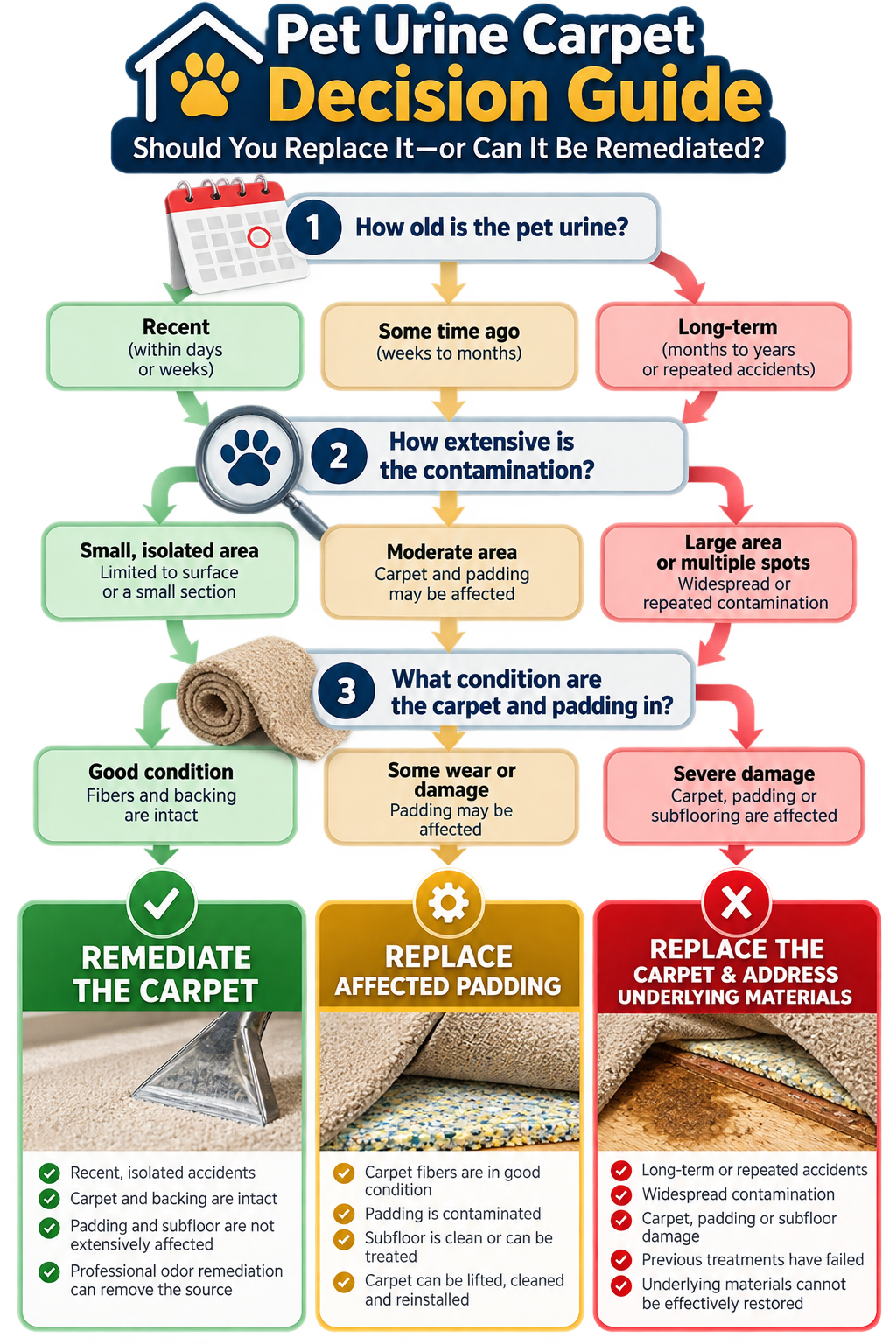
The Pet Urine Carpet Decision Guide: What Can Be Saved?
Use this practical decision guide before committing to a full carpet replacement.
| What You're Experiencing | What It May Indicate | Recommended Next Step |
|---|---|---|
| One recent accident, promptly addressed | Limited contamination | Clean promptly and monitor for recurring odor |
| Persistent odor in one small area | Localized contamination in carpet or padding | Request targeted odor assessment |
| Odor returns after carpet cleaning | Residual contamination below the cleaned surface | Evaluate backing, padding, and subfloor |
| Multiple accidents over several months | Possible deeper or widespread contamination | Assess extent before choosing remediation or replacement |
| Carpet backing or padding is deteriorating | Material may no longer be salvageable | Consider replacing affected materials |
| New carpet still smells like urine | Possible untreated underlying source | Inspect subfloor and adjacent materials |
| Strong odor throughout multiple rooms | Multiple sources or extensive contamination | Arrange a comprehensive source assessment |
The decision should be based on the actual condition of the materials, not odor intensity alone.
A strong odor does not automatically mean every carpeted surface is ruined, and a faint odor does not guarantee that contamination is superficial.
Can You Replace Only the Carpet Padding Instead of the Entire Carpet?
In certain situations, yes.
If the carpet fibers and backing remain in good condition but the padding beneath them is contaminated, replacing only the affected padding may be an option.
This approach generally requires carefully lifting the carpet, evaluating the padding, inspecting the subfloor, and determining whether the carpet can be properly cleaned and reinstalled.
However, not every carpet is suitable for removal and reinstallation.
Age, installation method, backing condition, and previous damage can affect whether the material can be preserved.
When practical, selective replacement can reduce unnecessary material waste while addressing contamination more thoroughly than surface cleaning alone.
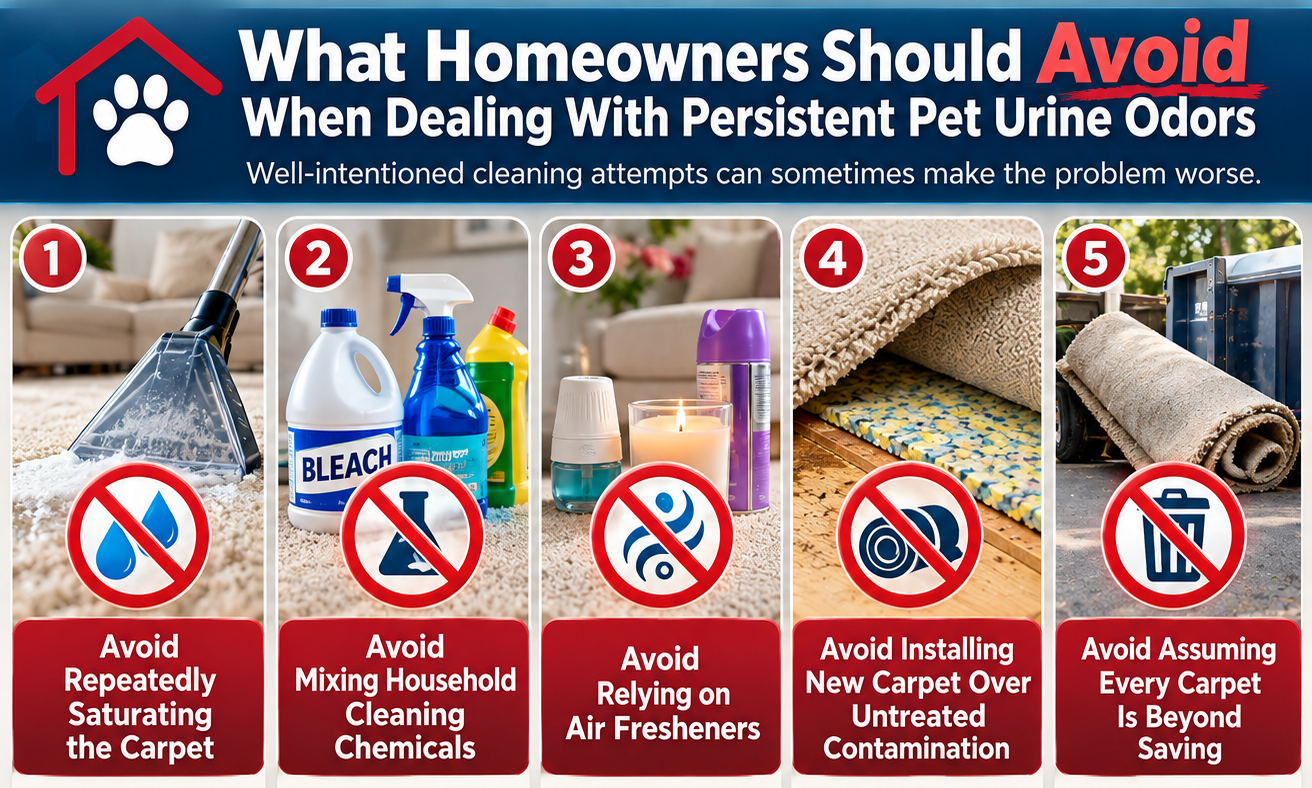
What Should Homeowners Avoid When Dealing With Persistent Pet Urine Odors?
Well-intentioned cleaning attempts can sometimes complicate an already difficult situation.
Avoid Repeatedly Saturating the Carpet
Excessive use of water or cleaning solutions may push moisture deeper into the padding or subflooring, particularly when extraction is inadequate.
Avoid Mixing Household Cleaning Chemicals
Combining cleaning products can create hazardous chemical reactions. Never mix bleach with ammonia-containing products or other cleaners unless the manufacturer explicitly states that combination is safe.
Avoid Relying on Air Fresheners
Fragrances may temporarily mask odors, but they do not necessarily remove urine residues or other contamination responsible for the smell.
Avoid Installing New Carpet Over Untreated Contamination
Before installing replacement carpet, inspect and address the underlying materials.
Avoid Assuming Every Carpet Is Beyond Saving
Discarding an otherwise serviceable carpet without evaluating the source of the odor can lead to unnecessary expenses.
How Carolina Odor Pros Helps Homeowners Make the Right Decision
At Carolina Odor Pros, we understand how frustrating persistent pet odors can be, especially when homeowners have already spent money on cleaning products and services without achieving lasting results.
Our approach centers on understanding the odor problem rather than automatically recommending that homeowners replace their carpeting.
Every property is different. The right solution depends on where the odor originates, which materials are affected, and whether the contamination can be effectively addressed.
For homeowners in Charlotte and surrounding North Carolina communities, professional odor assessment can help clarify whether existing carpeting may be preserved or whether additional flooring work should be considered.
Whether you're preparing a home for sale, addressing years of pet accidents, or simply trying to make your living space comfortable again, identifying the source is the first step.
Explore our Service Areas to learn more about available solutions.

Don't Replace Your Carpet Until You Know What Can Be Saved!
Why pay for new carpeting if the real odor problem is hiding underneath? Carolina Odor Pros helps homeowners identify the source of persistent pet urine odors, determine whether existing carpeting can be saved, and avoid unnecessary replacement costs. Get the answers you need before spending money on new flooring—only to have the same odor return.
Contact Carolina Odor Pros Today and find out what can be saved!


Frequently Asked Questions: Pet Urine Carpet Replacement vs. Remediation
1. Should I replace my carpet after pet urine accidents?
Not always. If contamination is limited and the carpet remains in good condition, professional odor remediation may eliminate the odor without requiring replacement.
2. Can pet urine smell be permanently removed from carpet?
Yes, in some cases. Lasting odor removal depends on identifying and treating the affected carpet, padding, and underlying materials.
3. How do I know if pet urine has reached the carpet padding?
Persistent odors after cleaning, recurring stains, or repeated accidents in the same location may indicate contamination beneath the carpet.
4. Will replacing carpet eliminate pet urine odors?
Not necessarily. If urine has penetrated the subfloor, odors may return even after installing new carpet and padding.
5. Can I replace carpet padding without replacing the carpet?
Yes. If the carpet remains structurally sound, contaminated padding may be replaced while preserving and treating the existing carpet.
6. Why does my carpet still smell like urine after professional cleaning?
Urine residues may remain in the carpet backing, padding, or subfloor, where ordinary carpet cleaning cannot adequately reach them.
7. Is professional pet urine remediation cheaper than carpet replacement?
It can be, especially for localized contamination. Costs depend on the affected area, treatment requirements, and condition of the underlying materials.
8. Does cat urine require carpet replacement more often than dog urine?
Not necessarily. Both can cause deep contamination. The severity, frequency, and duration of exposure matter more than the animal species alone.
9. Can pet urine damage wooden subfloors?
Yes. Repeated exposure can leave odor-producing residues in porous wood and contribute to moisture-related deterioration, sometimes requiring additional treatment or repairs.
10. How can Carolina Odor Pros help me decide whether to replace my carpet?
Carolina Odor Pros can help evaluate persistent pet odors and identify potential odor sources, allowing homeowners to make more informed decisions about remediation or replacement.
Ready to find out what can be saved? Visit Carolina Odor Pros to explore professional pet odor removal solutions.
Read Previous Article: Pet Urine in Carpet & Subfloor: What Really Happens? | Carolina OdorPros
Next Article: Why Does One Room Smell Bad but the Rest of the House Doesn't?