

Why Cat Urine Smell Is So Hard to Remove From a House
⏱️Estimated Read Time 8–10 minutes
Cat urine odor can be exceptionally difficult to eliminate because the contamination often extends far beyond the surface homeowners can see. Urine can penetrate carpet fibers, backing, padding, flooring seams, upholstery, baseboards, and porous subfloor materials, leaving residual contamination even after the visible area has been cleaned.
This article explains why cat urine odor can persist or seemingly return, how repeated accidents can create multiple hidden odor sources, why humidity may make residual odors more noticeable, and why surface cleaning or fragrance-based products may provide only temporary improvement. For persistent problems, identifying the location, depth, and extent of contamination is an important step in determining an appropriate treatment strategy.
Key Takeaways
- Cat urine can travel below the visible surface. Carpet may look clean while contamination remains in padding, subflooring, flooring seams, or surrounding materials.
- Surface cleaning may not reach the entire contamination zone. A cleaning product can only address materials it actually reaches.
- Repeated accidents can create a larger problem. Multiple contamination points can exist throughout a room, including carpet edges, baseboards, furniture, and vertical surfaces.
- Humidity can make residual odors more noticeable. An odor that seems to disappear and return may indicate that contamination is still present.
- Black lights can assist with source detection, but they are not definitive. Other substances can fluoresce, so UV inspection should be considered one investigative tool rather than absolute proof of urine contamination.
- Replacing carpet doesn't always solve the problem. If urine reached the padding, subfloor, baseboards, or adjacent materials, the odor source may remain after the carpet is removed.
- Odor masking is different from odor removal. Fragrances may temporarily change what a room smells like without addressing the underlying source.
- Persistent odor requires source identification. Determining where contamination is located and how deeply it has penetrated can help guide the appropriate treatment.
- Homeowners can become accustomed to persistent odors. Olfactory adaptation may make occupants less aware of an odor that visitors or prospective buyers notice immediately.
- Recurring cat urine odor may warrant a professional assessment. When repeated cleaning hasn't worked or the source cannot be located, Carolina Odor Pros can evaluate the affected area and help determine the next appropriate step.
You cleaned the carpet. You scrubbed the floor. You sprayed an odor remover. For a day or two, the room seemed better.
Then the smell came back.
Cat urine can be one of the most persistent household odors because the problem is often much deeper than what you can see—or even where you think the accident happened. Urine can move through carpet fibers, padding, flooring seams, upholstery, baseboards, and other porous materials. Once residues remain below the surface, ordinary cleaning may improve the room temporarily without eliminating the underlying odor source.
For homeowners dealing with recurring cat urine odor, understanding why the smell keeps returning is the first step toward determining what actually needs to be treated.
Why Does Cat Urine Smell So Strong?
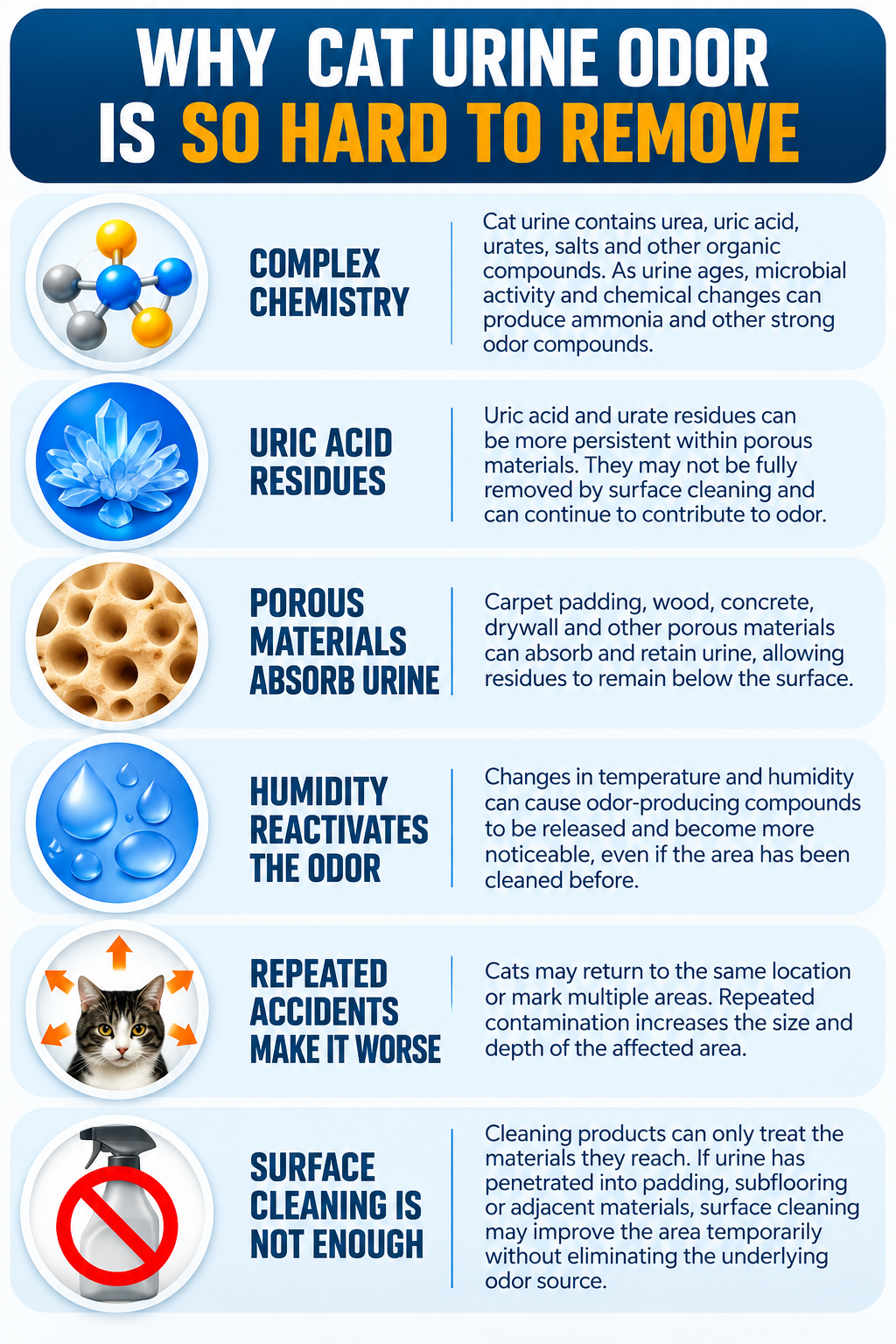
Fresh cat urine is largely water, but it also contains urea, salts, uric acid and other organic compounds.
As urine sits, microorganisms can break down some of its components. Urea can eventually contribute to the formation of ammonia and other volatile compounds associated with the characteristic sharp odor of old urine.
The longer contamination remains untreated, the more complicated the odor problem can become.
This is one reason there can be a noticeable difference between cleaning a fresh accident immediately and discovering an area that has been repeatedly contaminated over weeks or months.
The Uric Acid Problem
One particularly important component is uric acid and its associated urate residues.
Some urine components can be removed relatively easily with water-based cleaning. Others are much more persistent once they become deposited within porous materials.
That distinction helps explain a frustrating experience many homeowners recognize:
The carpet looks clean, but the room still smells.
Cleaning the visible surface does not necessarily mean all of the contamination beneath that surface has been removed.
Also Read 🐈Pet Urine in Carpet & Subfloor: What Really Happens? | Carolina OdorPros
Cat Urine Doesn't Always Stay on the Carpet
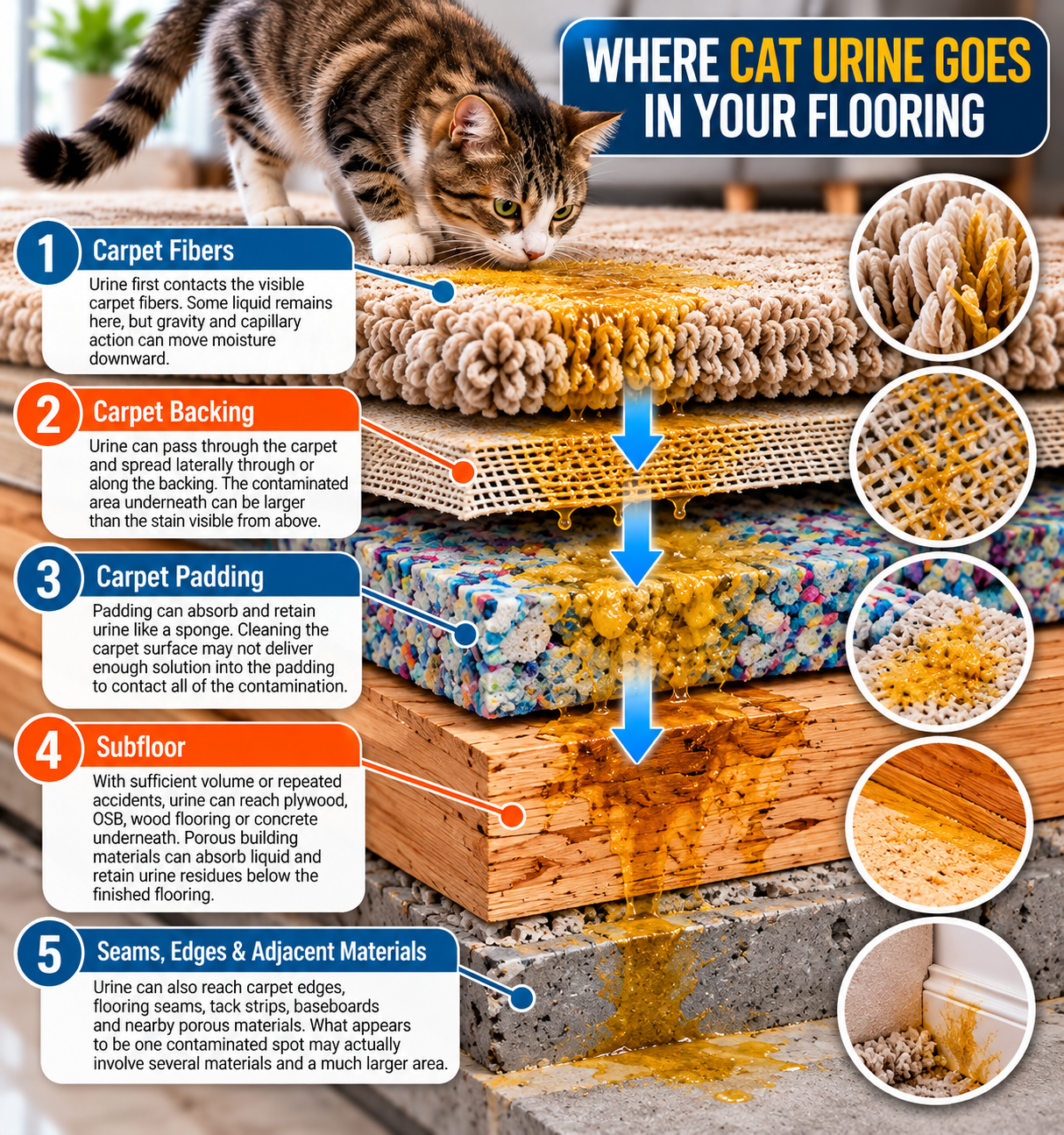
Imagine pouring a small amount of water onto carpet.
It doesn't simply sit on top.
Liquid moves through the carpet fibers and may continue downward into:
Carpet → backing → padding → subfloor
Urine can behave similarly.
Depending on the amount of liquid, flooring construction and how quickly the accident is discovered, contamination may spread beyond the immediately visible area.
Repeated accidents in approximately the same location can make the problem considerably worse.
Over time, urine may affect:
- Carpet fibers
- Carpet backing
- Carpet padding
- Wood subflooring
- Concrete
- Grout
- Baseboards
- Drywall near marking locations
- Upholstered furniture
- Mattresses
- Area rugs
- Flooring seams and edges
This is why treating only the upper carpet fibers may not resolve a persistent odor.
Why Does Cat Urine Smell Come Back When It's Humid?
Homeowners sometimes notice something strange:
The house seems fine during dry weather, but the odor becomes much more noticeable when humidity rises.
That doesn't necessarily mean the cat had another accident.
Changes in temperature and humidity can affect how odor-producing compounds are released and perceived within an indoor environment. Moisture can also interact with contaminated porous materials and make previously less noticeable odor sources easier to detect.
The result can feel like the odor has suddenly "returned."
In reality, the original source may never have been completely addressed.
This is an important clue.
If a room repeatedly smells worse during humid weather, after the HVAC system changes operation, or when the home has been closed for several hours, there may still be contamination somewhere in the structure or furnishings.
Also Read 📖Pet Urine Odor Removal in the Carolinas | Carolina Odor Pros
The Source May Be Larger Than the Spot You Found
Another challenge with cat urine odor removal is determining where the contamination actually is.
The visible stain doesn't always tell the whole story.
Cats may repeatedly return to the same area, but they may also mark several locations throughout a home. Vertical surfaces can be particularly easy to overlook when spraying or territorial marking is involved.
Potential areas can include:
- Corners of rooms
- Baseboards
- Door frames
- Furniture legs
- Curtains
- Walls
- Closets
- Carpet edges
- Behind furniture
- Around litter-box areas
A homeowner may clean one obvious spot while several smaller contaminated areas continue contributing to the overall odor.
One Cat Can Create Multiple Odor Sources
This becomes especially important in homes with a history of repeated accidents.
Suppose one obvious carpet stain is cleaned successfully.
If urine is also present along a baseboard, underneath a sofa and in another section of carpet, the homeowner may conclude that the cleaner "didn't work."
The real issue may be incomplete source identification.
That's why persistent odor problems often require investigation before treatment.
Also Read 📖Why Does My House Smell Musty Even When It’s Clean?
Why Household Fragrances Don't Solve the Problem
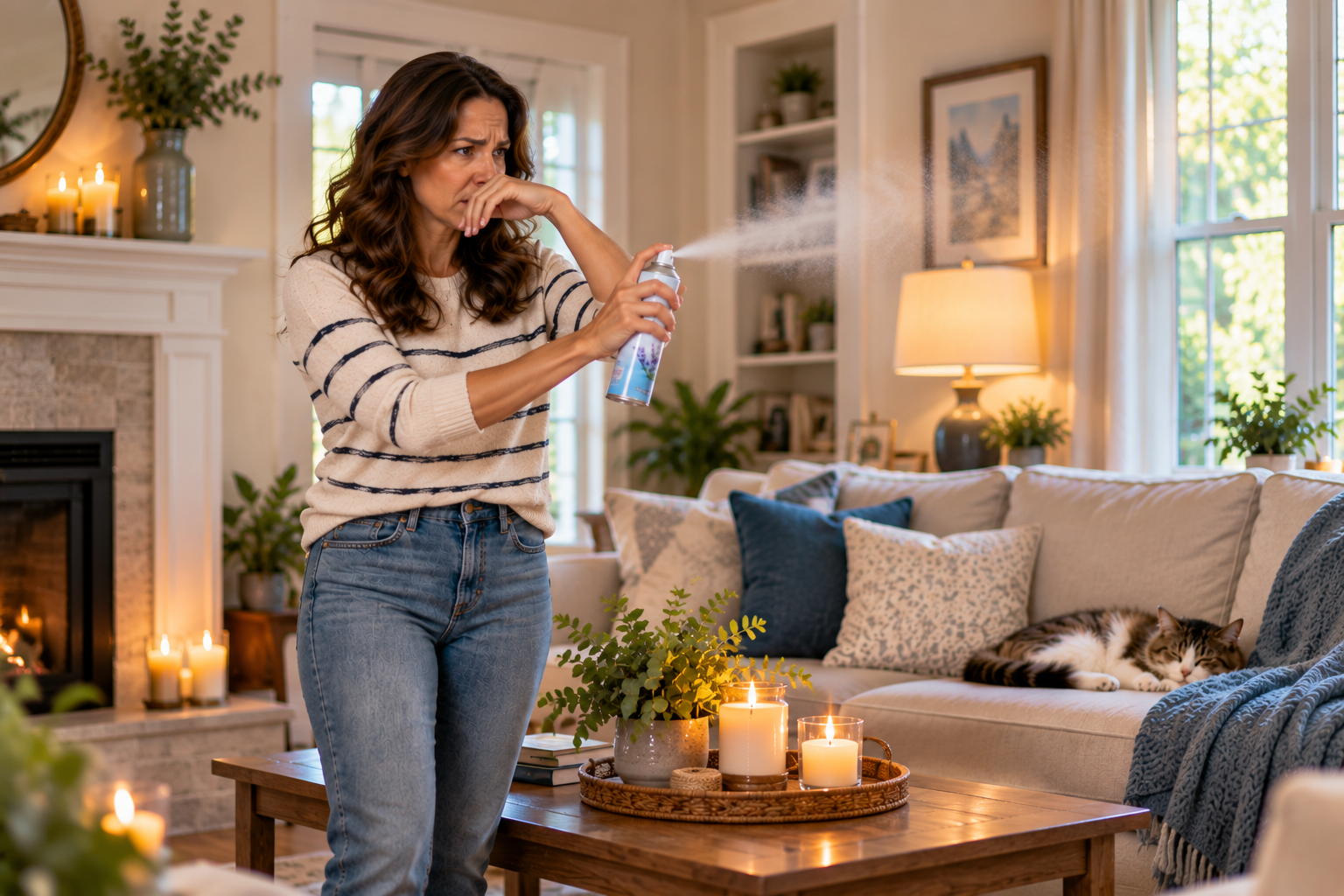
Air fresheners, scented sprays, candles and other fragrances can change what a room smells like temporarily.
They do not remove urine contamination from carpet padding, subflooring or other porous materials.
In some situations, adding fragrance can actually make identifying the original source more difficult because multiple odors are now competing in the room.
A better strategy is:
Find the source → determine how far it traveled → treat the affected material appropriately → verify the result.
Odor removal and odor masking are fundamentally different processes.
Why Repeated Surface Cleaning Can Fail
Consider a carpet accident that has reached the padding.
A homeowner cleans the top of the carpet.
The carpet fibers may now be significantly cleaner.
But if urine remains in the padding underneath, the primary odor reservoir may still be present.
The same principle applies when contamination reaches a subfloor.
At that point, cleaning becomes less about making the visible surface look better and more about determining which materials contain contamination.
That distinction matters.
Surface Appearance Is Not the Same as Odor Removal
This is especially relevant when preparing a home for:
- Sale
- Rental turnover
- New tenants
- Guests
- Renovation
- New flooring
A room can appear perfectly clean while still containing an odor source beneath the finished surface.
For homeowners preparing to sell a property, persistent pet odor can become particularly important because someone entering the house for the first time may notice an odor the occupants have gradually become accustomed to.
What About Enzyme Cleaners?
Enzyme-based pet urine products can be useful in appropriate situations, particularly when a fresh accident is identified quickly and the product is compatible with the affected material.
But no product can treat contamination it doesn't reach.
If urine penetrated several layers beneath the surface, applying a small amount of cleaner to the top of the carpet may not deliver enough treatment to the deeper affected material.
That doesn't necessarily mean the chemistry failed.
It may mean the treatment never reached the entire contamination zone.
This is another reason source detection and contamination depth matters.
Why Black Lights Can Help—but Aren't the Whole Answer
UV inspection tools are sometimes used when investigating pet urine contamination because certain residues may fluoresce under appropriate conditions.
They can be helpful investigative tools.
However, fluorescence alone is not definitive proof that every glowing area is urine. Cleaning products, beverages and other substances can also fluoresce.
Likewise, environmental conditions and previous cleaning can affect what is visible.
Professional odor investigation therefore shouldn't depend on one tool alone.
The goal is to combine observations and available detection methods to develop a more complete picture of the affected area.
When Cat Urine Reaches the Subfloor
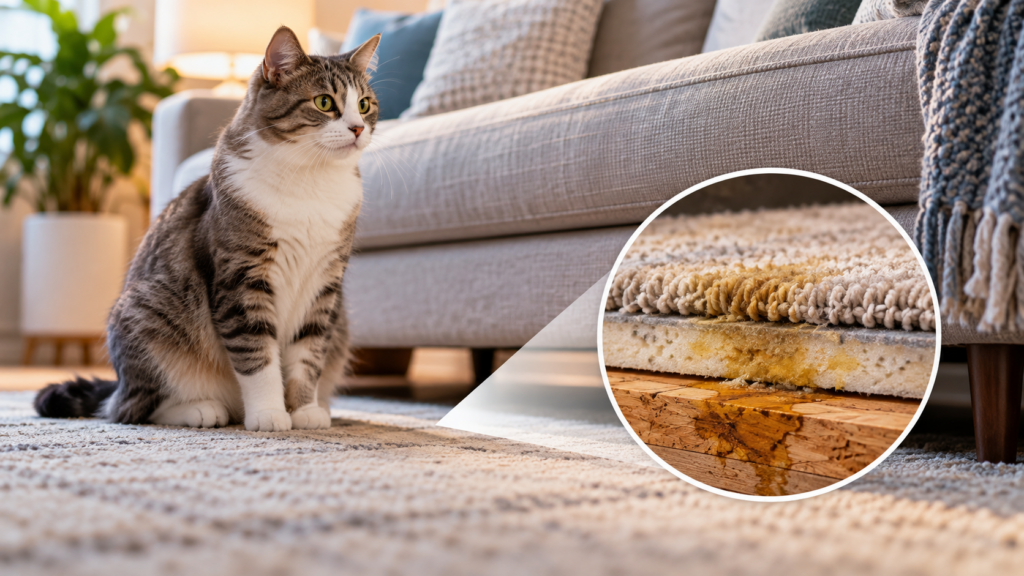
This is where odor removal can become significantly more complicated.
If urine passes through carpet and padding, it may reach plywood, oriented strand board, hardwood, concrete or another underlying material.
Porous building materials can absorb liquid.
Repeated contamination increases the possibility that urine residues have moved beyond the flooring surface.
Depending on the material and severity of contamination, effective remediation may require treatment beyond conventional carpet cleaning.
In more severe situations, affected materials may need specialized treatment, sealing or replacement.
The appropriate solution depends on what is contaminated—not simply how strong the room smells.
Why Professional Source Detection Matters
Professional pet odor remediation should begin with investigation rather than simply spraying a deodorizer throughout the room.
The important questions include:
Where is the contamination?
How extensive is it?
Which materials are affected?
Has urine reached padding or structural surfaces?
Are there multiple odor sources?
Has the area already been treated with other chemicals?
The answers help determine an appropriate treatment strategy.
This is particularly important because two homes that smell similar may have completely different underlying problems.
One may have a relatively localized carpet accident.
Another may have years of repeated contamination involving carpet, padding, baseboards and subflooring.
Those situations shouldn't automatically receive identical treatment.
Cat Urine Odor and Real Estate
Persistent pet odor can become especially important when selling or purchasing a home.
People who live with an odor every day can experience olfactory adaptation, meaning they gradually become less aware of it.
A prospective buyer walking through the front door doesn't have that adaptation.
They may notice it immediately.
For sellers, attempting to cover pet odor with fragrances before a showing can create another problem: buyers may wonder what the fragrance is intended to conceal.
Identifying and addressing the actual source before listing the property is generally a much stronger approach.
For buyers, unexplained pet odor can also warrant closer investigation because the contamination may extend beyond the visible flooring.
When Should You Consider Professional Cat Urine Odor Removal?
A single fresh accident on a washable surface is very different from a recurring whole-room odor.
Professional assessment becomes more reasonable when:
- The odor returns after cleaning
- You cannot locate the source
- Multiple accidents have occurred
- The contamination is old
- The smell becomes stronger during humid weather
- Urine may have reached carpet padding or subflooring
- Furniture or walls may be involved
- You're preparing a home for sale
- You're purchasing a home with an unexplained pet odor
- Previous cleaning attempts haven't solved the problem
At that point, continuing to purchase different cleaners may simply repeat the same process without identifying why the odor remains.
Start With the Source, Not the Smell
Persistent cat urine odor isn't simply an air-quality problem.
Somewhere in the environment is a source.
Successful odor remediation therefore begins by finding that source and determining how extensively surrounding materials have been affected.
That may mean looking beyond the obvious carpet stain.
It may mean examining padding, flooring edges, baseboards, furniture or the subfloor beneath the room.
And sometimes, it means discovering that what appeared to be one accident is actually several contaminated areas contributing to the same odor.
If you haven't already, read our previous guide, “What Really Happens When Pet Urine Soaks Into Carpet and Flooring?” It explains how urine can move from the carpet surface into padding and subflooring—and why deeper contamination changes the approach to odor removal.
Stop Guessing Where the Odor Is Coming From
If you've cleaned repeatedly and the cat urine smell keeps returning, another bottle of cleaner may not be the answer.
The next step is determining where the contamination is and how deep it goes.
Carolina Odor Pros helps homeowners investigate persistent pet odor problems and develop a treatment approach based on the conditions found in the home.
Schedule a Pet Odor Assessment
If cat urine odor is lingering in your home, contact Carolina Odor Pros to schedule a Pet Odor Assessment.
Finding the source is the first step toward solving the problem instead of temporarily covering it up.


Frequently Asked Questions About Cat Urine Odor Removal
1. Why is cat urine smell so hard to remove?
Cat urine can be difficult to remove because the liquid may penetrate beyond the visible surface into carpet backing, padding, flooring seams, subfloors, upholstery, baseboards, and other porous materials. Even when the surface appears clean, residues can remain deeper in the material and continue contributing to odor.
2. Why does cat urine smell come back after cleaning?
If cat urine odor returns after cleaning, contamination may remain beneath the surface or in another location that was never treated. Changes in temperature and humidity can also affect how noticeable residual odors are, making a previously treated room seem as though the smell has returned.
3. Can cat urine soak through carpet into the subfloor?
Yes. Depending on the amount of urine, how quickly it is cleaned, and whether repeated accidents occurred in the same area, urine can pass through carpet fibers and backing into the padding and eventually reach the subfloor. Once porous structural materials are affected, surface carpet cleaning alone may not address the entire contamination area.
4. Will enzyme cleaners completely remove cat urine odor?
Enzyme-based cleaners can be useful for certain pet urine situations when used correctly and on compatible materials, but the product must reach the contaminated material to be effective. If urine has penetrated into padding, subflooring, furniture, or other deeper materials, treating only the surface may not resolve the entire odor problem.
5. Why does cat urine smell stronger when it is humid?
Changes in humidity can influence how odor-producing compounds are released from contaminated materials and how noticeable those odors become indoors. If cat urine odor repeatedly becomes stronger during humid weather, it can be a sign that residual contamination remains somewhere in the room or surrounding materials.
6. Can a black light find cat urine in a house?
UV or black-light inspection can help identify certain residues that fluoresce, making it a useful tool when investigating possible urine contamination. However, fluorescence alone does not prove that a spot is cat urine because some cleaning products, beverages, and other substances can also fluoresce. It is best used as one part of a broader source-detection process.
7. Can cat urine odor remain after replacing the carpet?
Yes. Replacing carpet may not eliminate the odor if urine previously penetrated the carpet and padding and reached the subfloor, baseboards, walls, or other materials. The underlying contamination should be identified and appropriately addressed before new flooring is installed.
8. Can you become used to cat urine smell in your own house?
Yes. The human sense of smell can adapt to an odor after prolonged exposure, a process known as olfactory adaptation. This can make occupants less aware of an odor that a visitor, prospective homebuyer, or other person entering the home may notice quickly.
9. When should I call a professional for cat urine odor?
Professional assessment may be appropriate when the odor continues after repeated cleaning, the source cannot be located, multiple accidents have occurred, urine may have reached the padding or subfloor, or the odor involves several rooms or surfaces. An assessment can help determine where contamination exists and which materials may require treatment.
10. How does Carolina Odor Pros determine where cat urine odor is coming from?
Carolina Odor Pros begins by evaluating the affected area and looking for potential odor sources rather than simply masking the smell. Depending on the conditions in the home, the assessment can consider visible evidence, the history and location of pet accidents, affected materials, and source-detection methods to better understand the extent of contamination and determine an appropriate treatment approach.
Previous Article: Pet Urine in Carpet & Subfloor: What Really Happens? | Carolina OdorPros
Next Article: Should You Replace Carpet After Pet Urine—or Can It Be Remediated?