

What Really Happens When Pet Urine Soaks Into Carpet and Flooring?
Reading Time: About 7 minutes
You clean the spot. The stain disappears. The carpet dries.
Then a few days later—or on a warm, humid afternoon—you notice it again.
That unmistakable pet urine odor.
The frustrating part is that the carpet may look perfectly clean.
So why does the smell keep coming back?
Because the stain you see on top of the carpet may represent only a portion of the affected area. When enough liquid is deposited, pet urine can move downward through carpet fibers, through the carpet backing, into the padding and potentially reach the flooring or subfloor underneath.
North Carolina State Extension specifically warns homeowners that pet urine can seep into carpet and cause both damage and odors. And when odor remains after repeated cleaning, veterinary guidance from The Ohio State University notes that replacing contaminated padding and cleaning beneath the carpet may become necessary.
The problem, in other words, may no longer be on the carpet.
It may be under it.
A Pet Urine Accident Happens in Layers
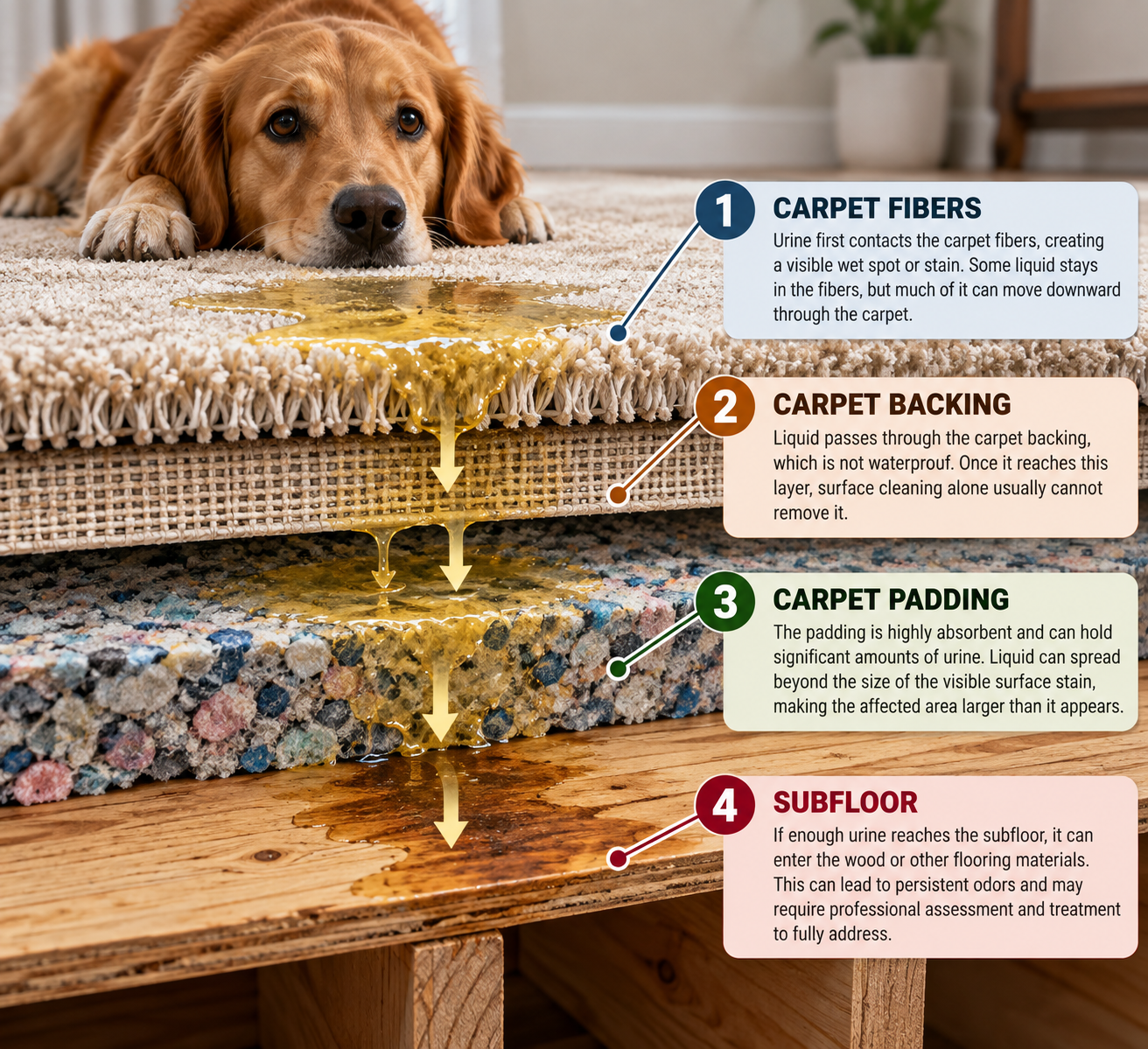
Most residential carpet installations aren't a single surface.
Think of your floor as a layered system:
Carpet fibers
↓
Carpet backing
↓
Carpet padding or cushion
↓
Subfloor
↓
Floor structure
When a small accident is discovered immediately, much of the liquid may be recoverable from the carpet.
But the longer urine remains—or the larger the volume—the more opportunity it has to migrate downward.
This is where homeowners can underestimate the size of the problem.
The visible stain at the surface doesn't necessarily show how far the liquid traveled underneath.
Layer 1: The Carpet Fibers
The carpet pile is the first material urine encounters.
Some of the liquid remains around the fibers, creating the visible wet spot or stain. Immediate blotting can remove a portion of fresh contamination before it travels farther.
But carpet isn't designed to be a waterproof barrier.
Liquid can continue downward between the fibers and toward the backing.
Layer 2: The Carpet Backing
Underneath the carpet fibers is the backing that holds the carpet structure together.
Urine reaching this level is already below what ordinary surface wiping can effectively address.
And once liquid passes through the backing, another highly absorbent material may be waiting underneath.
Layer 3: The Carpet Padding
This is where pet urine problems can become much more difficult.
Carpet padding is designed to provide cushioning—not to stop liquids.
Depending upon the type of padding and installation, urine reaching this layer can spread beyond the dimensions of the original surface spot.
That creates an important distinction:
The spot you can see may not represent the entire affected area.
A homeowner might clean a six-inch stain at the surface while contamination underneath has reached a larger section of padding.
If the padding continues to hold odor-producing residue, cleaning only the carpet fibers may improve the smell temporarily without addressing everything underneath.
Ohio State's Indoor Pet Initiative specifically advises that when odor remains severe and a cat continues returning to an area despite cleaning, the padding underneath may need to be replaced and the area beneath the carpet cleaned.
Then Pet Urine Can Reach the Subfloor
Below the carpet and padding sits the subfloor.
In many homes, this may consist of plywood or oriented strand board (OSB). Other flooring systems may involve concrete or different materials.
These surfaces behave differently when exposed to liquid.
Wood-based materials are porous. If urine reaches an unfinished or inadequately protected wood subfloor, some of that liquid can enter the material rather than simply sitting on top.
Repeated accidents can make the situation more complicated.
Imagine a dog repeatedly choosing roughly the same corner of a room.
One accident reaches the carpet.
Another reaches the padding.
Another adds additional contamination.
Over time, the affected area may become a multi-layer odor source involving more than the carpet itself.
At that point, shampooing the visible surface is addressing only one component of the problem.
Why Does Old Pet Urine Smell Different From Fresh Urine?
Fresh urine and an older urine deposit aren't chemically identical environments.
Urine contains water along with urea, salts and numerous metabolic compounds. As the deposit ages, microorganisms and chemical processes change some of those compounds. Urea can ultimately contribute to the production of ammonia, which helps explain the sharper odor associated with aging urine contamination.
Meanwhile, water evaporates.
The liquid may disappear, but that does not necessarily mean everything deposited with it disappears.
Residues can remain behind in carpet, padding and porous building materials.
That distinction explains one of the most confusing things homeowners experience:
Dry doesn't necessarily mean odor-free.
The accident may have happened weeks or months ago even though odor remains associated with the affected materials.
Why Does the Pet Urine Smell Sometimes Come Back?
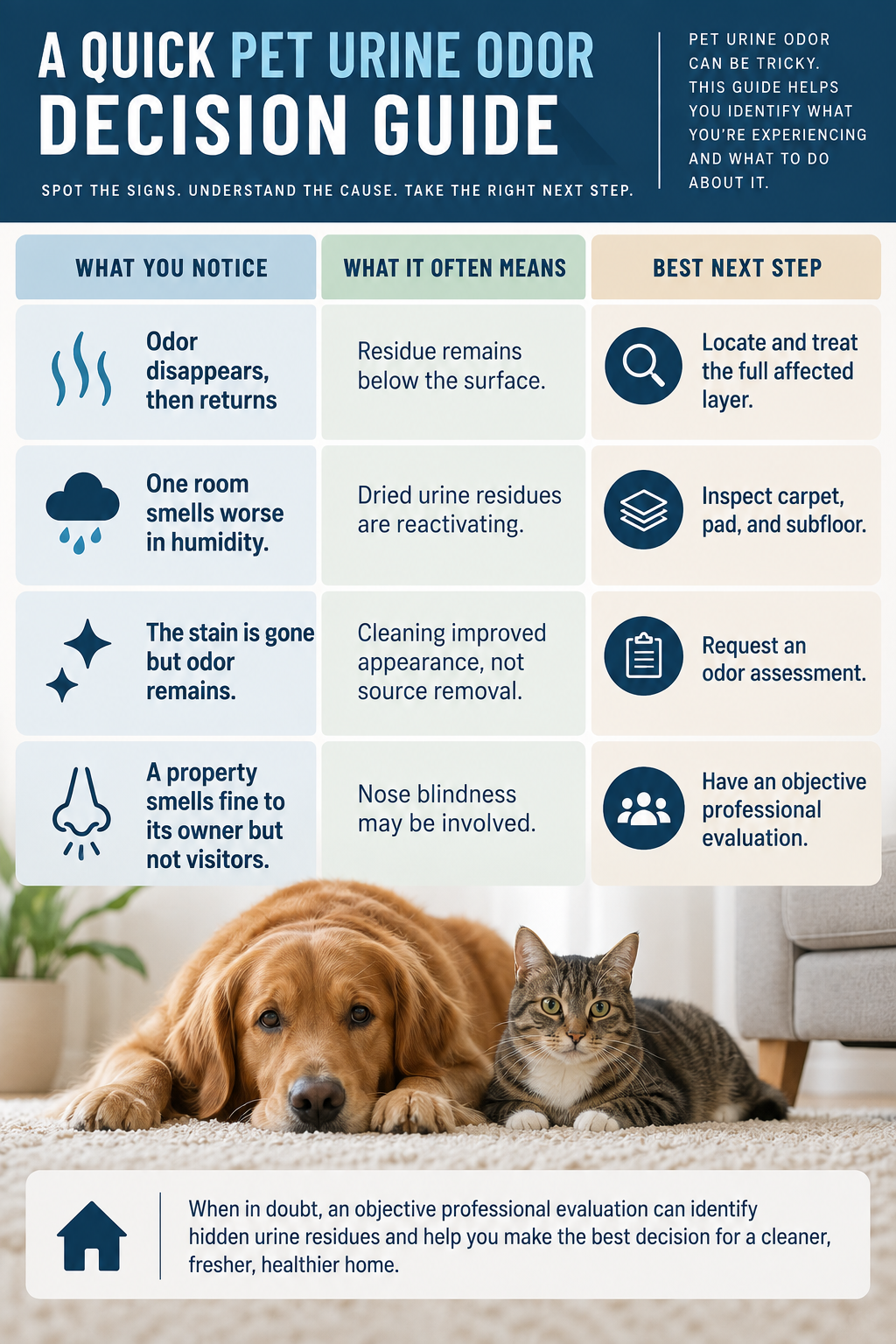
Homeowners often tell odor professionals something interesting:
"We thought we got rid of it, but now we can smell it again."
There are several possible reasons.
Humidity Changes the Indoor Environment
Materials within a home continuously interact with moisture in the surrounding air.
Changes in relative humidity can influence how odors are perceived and how volatile compounds move through an indoor environment.
That's one reason an odor may appear more noticeable during certain weather conditions or seasons.
In the Carolinas, where warm and humid conditions are common for portions of the year, homeowners may notice persistent household odors behaving differently as indoor conditions change.
The Surface Was Cleaned, but the Source Wasn't
This is perhaps the most important explanation.
A carpet-cleaning product may successfully improve the visible carpet while contamination remains in the padding or underneath.
The carpet looks better.
The immediate smell improves.
Then the odor returns.
The cleaner didn't necessarily "fail."
It simply may not have reached the full depth of the contamination.
Multiple Accidents Have Accumulated
A single accident discovered quickly is very different from repeated pet marking over months or years.
Dogs and cats can also be attracted to areas that have previously been soiled. Veterinary guidance recommends thoroughly removing urine odors partly because residual odor can encourage pets to return to previously contaminated locations.
That can create a cycle:
Accident → incomplete odor removal → pet returns → additional contamination → deeper odor problem.
The homeowner may eventually discover that what appeared to be one troublesome spot is actually the result of repeated incidents.
Also Read 📖Why Does My House Smell Musty Even When It’s Clean?
Why More Cleaner Isn't Always the Answer
Once an odor returns, the natural reaction is:
"I'll clean it again."
Sometimes that is appropriate.
But repeatedly saturating a carpet without knowing where the original contamination traveled isn't necessarily solving the underlying problem.
The more useful question becomes:
Where is the odor source now?
Is contamination limited to:
- Carpet fibers?
- Carpet backing?
- Padding?
- Tack strips?
- Baseboards?
- Wood subfloor?
- Concrete?
- An adjacent wall or flooring edge?
- Several of these materials?
Until you understand the extent of the affected area, you're treating what you can see rather than necessarily treating what is producing the odor.
Carpet Cleaning and Odor Remediation Aren't Always the Same Job
This distinction matters.
Carpet cleaning primarily addresses the condition of the carpet.
Persistent odor remediation focuses on identifying and addressing the source of the odor.
Sometimes those are the same thing.
Sometimes they aren't.
A relatively fresh accident may be confined primarily to the carpet.
A long-term pet urine problem can involve carpet, padding and underlying materials.
This is why Carolina OdorPros begins its pet odor process with an inspection intended to identify where odors are coming from and determine the extent of the problem before treatment begins.
Learn more about Carolina OdorPros Pet Odor Removal Services.
How Can You Tell When Pet Urine May Have Reached Below the Carpet?
You cannot determine the full extent of every pet urine problem by appearance alone.
However, several clues suggest that the problem deserves a closer look.
Pay attention when:
- The odor returns after the carpet has been cleaned.
- The smell remains even though no visible stain is present.
- A pet repeatedly used the same location.
- The carpet was heavily saturated during an accident.
- The odor appears concentrated around carpet edges or baseboards.
- Carpet and padding are older and have experienced years of pet accidents.
- You're preparing a previously pet-occupied property for sale or rental.
- You recently purchased a home and discovered an unexplained pet odor.
These signs don't automatically mean the subfloor is contaminated.
They mean it may be time to stop guessing.
What About Hardwood, Laminate and Other Flooring?
Carpet isn't the only flooring vulnerable to pet urine.
Hardwood
Urine can enter joints between boards and potentially affect unfinished or damaged wood. Repeated exposure can also contribute to discoloration or changes in the finish.
Laminate Flooring
Liquid entering seams may reach the core material beneath the wear layer. Depending on the flooring construction and amount of moisture involved, swelling or deterioration may occur.
Luxury Vinyl and Other Floating Floors
The flooring itself may be relatively resistant to moisture, but liquid can sometimes move through seams or perimeter gaps and reach materials underneath.
Concrete
Concrete may look solid, but it is porous.
Odor contamination involving concrete therefore requires a different evaluation than contamination limited to carpet fibers.
The correct approach depends on the material involved.
That's another reason one universal DIY treatment cannot be expected to solve every pet urine problem.
Check Out Our Services
Before Replacing the Carpet, Find Out What's Underneath
This is especially important for homeowners, landlords, property managers and real estate professionals.
Replacing contaminated carpet may seem like the obvious solution.
But imagine installing beautiful new carpet over an odor source that remains in the padding area, subfloor or surrounding materials.
You've replaced the surface without necessarily addressing the source.
Before major flooring replacement, persistent pet odor should be investigated so you understand what you're dealing with.
That can help determine whether the problem is limited to removable flooring materials or whether underlying surfaces also require attention.
📖 Also Read: Pet Urine Odor Removal in Carolina Homes
If you're dealing with a recurring pet urine smell, start with our previous guide:
Pet Urine Odor Removal: Why the Smell Keeps Coming Back and What Actually Works
It explains why pet urine odors can persist and why eliminating the odor source is different from simply covering the smell.
Don't Chase the Smell—Find the Source
Persistent pet odor isn't necessarily a sign that your home is dirty.
It may simply mean the source is somewhere ordinary cleaning isn't reaching.
When pet urine has penetrated beyond the carpet surface, the question changes from:
"What should I clean this with?"
to:
"How far did this actually go?"
That's the question a professional assessment is designed to answer.
Carolina OdorPros provides professional pet odor services throughout the Charlotte region and surrounding North Carolina communities, as well as Fort Mill, Rock Hill and other communities in South Carolina.
If you've cleaned the carpet and the odor keeps returning, don't keep covering it with fragrances or repeatedly treating the same visible spot.
Find out what's underneath it.
Request a Professional Pet Odor Assessment
Carolina OdorPros can evaluate the affected area, help identify the odor source and determine whether contamination appears limited to the surface or has reached deeper materials.


Frequently Asked Questions About Pet Urine in Carpet and Flooring
1. Can pet urine soak all the way through carpet?
Yes. Carpet is not waterproof. Sufficient liquid can pass through the carpet fibers and backing and reach the padding underneath. North Carolina State Extension specifically notes that pet urine can seep into carpet and contribute to odors and damage.
2. Can dog urine reach the subfloor?
Yes. If enough urine penetrates the carpet and padding, it can reach the underlying subfloor. The likelihood increases with larger accidents, repeated contamination in the same area, and accidents that remain untreated.
3. Why does my carpet still smell like urine after cleaning?
One possibility is that odor-producing residue remains below the carpet surface. The visible carpet may have been cleaned while contamination remains in the padding, subfloor, or other underlying materials.
4. Can carpet padding hold pet urine odor?
Yes. Carpet padding can absorb liquid that penetrates through the carpet. When significant urine contamination reaches the padding, cleaning the carpet surface alone may not address the complete odor source.
5. Does replacing carpet automatically eliminate pet urine odor?
Not necessarily. If contamination has reached the padding, subfloor, tack strips, or adjacent materials, replacing only the carpet may leave part of the odor source behind.
6. Why does old pet urine sometimes smell stronger again?
Changes in temperature, humidity, airflow, and the condition of contaminated materials can affect how noticeable an odor becomes. An odor that seems to disappear temporarily may become detectable again under different indoor conditions.
7. Can pet urine damage hardwood flooring?
Repeated or prolonged exposure can potentially affect wood flooring, particularly when urine enters seams or reaches unfinished wood. The extent of the problem depends on the flooring construction, finish, duration of exposure, and amount of contamination.
8. Can pet urine get underneath vinyl or laminate flooring?
It can. Liquid may enter seams, edges, or perimeter gaps and reach materials beneath some flooring systems. An inspection may be necessary to determine whether contamination exists below the visible flooring surface.
9. Should I keep shampooing carpet if the urine smell keeps returning?
Repeated surface cleaning may not solve a problem originating below the carpet. If the odor repeatedly returns after appropriate cleaning, identifying the actual source and depth of contamination is a better next step than continuing to treat only the visible surface.
10. When should I request a professional pet odor assessment?
Consider a professional assessment when odor persists after cleaning, pets have repeatedly soiled the same area, contamination may have reached the flooring or subfloor, or you're preparing a pet-occupied property for sale, rental, or new flooring installation.
Previous Article: Pet Urine Odor Removal in the Carolinas | Carolina Odor Pros
Next Article: Why Cat Urine Smell Is So Hard to Remove From a House