

Cigarette Smoke Contamination: What Home Renovations Can—and Cannot—Remove
⏱️Estimated Reading Time: 6 Minutes
Executive Brief ⏱️60sec. Read
Renovating a home with a history of indoor cigarette smoking requires more than cosmetic improvements. Tobacco smoke deposits chemical residues on surfaces and within porous building materials, creating contamination that may persist long after smoking has stopped. While replacing flooring, repainting walls, and upgrading ventilation systems can improve a property's condition, these improvements do not necessarily eliminate embedded smoke residues.
Understanding the difference between cosmetic renovation, odor remediation, and contaminant removal is essential when determining an effective restoration strategy.
Key Takeaways
- Smoke contamination can outlast previous occupants. Chemical residues may remain in building materials for months or years.
- Renovation methods have different limitations. Cleaning, painting, sealing, and material replacement do not accomplish the same thing.
- Scientific research confirms measurable residual contamination. A 2026 systematic review found higher surface nicotine concentrations in previously smoked-in homes.
- The order of restoration matters. Evaluating contamination before installing new finishes can prevent unnecessary rework and expense.
The Science Behind Cigarette Smoke Contamination
Cigarette smoke contains a complex mixture of gases, particles, and chemical compounds. During indoor smoking, some of these substances settle onto household surfaces, while others are absorbed into furnishings and porous building materials.
The resulting contamination is commonly called thirdhand smoke.
Unlike secondhand smoke, which refers to smoke released into the air during smoking, thirdhand smoke consists of chemical residues that remain afterward.
According to the U.S. Environmental Protection Agency, tobacco-related chemicals can accumulate on walls, floors, carpeting, upholstery, and other surfaces. Some may subsequently be released back into indoor air.
This distinction matters during renovation because removing visible staining or unpleasant odors does not necessarily remove the underlying chemical residues.
What 2026 Research Reveals About Previously Smoked-In Homes
A systematic review published in July 2026 in the Journal of Exposure Science & Environmental Epidemiology analyzed 21 studies involving 3,167 measurements of nicotine residue.
Researchers identified a clear relationship between a building's smoking history and the concentration of nicotine remaining on indoor surfaces.
Measured Surface Nicotine Residue
| Residential smoking history | Weighted median nicotine |
|---|---|
| Long-term nonsmoking homes | 0.97 µg/m² |
| Previously smoked-in homes | 4.57 µg/m² |
| Homes with ongoing indoor smoking | 51.09 µg/m² |
Previously smoked-in homes had approximately 4.7 times the surface nicotine concentration of homes with long-standing indoor smoking bans.
These figures represent pooled research findings, not expected measurements for every property. Surface nicotine is also a contamination marker, not a complete measurement of health risk.
Nevertheless, the findings establish an important point: a home's smoking history can remain chemically detectable even after indoor smoking has stopped.
Read the complete 2026 scientific review.
How Cigarette Smoke Affects Building Materials
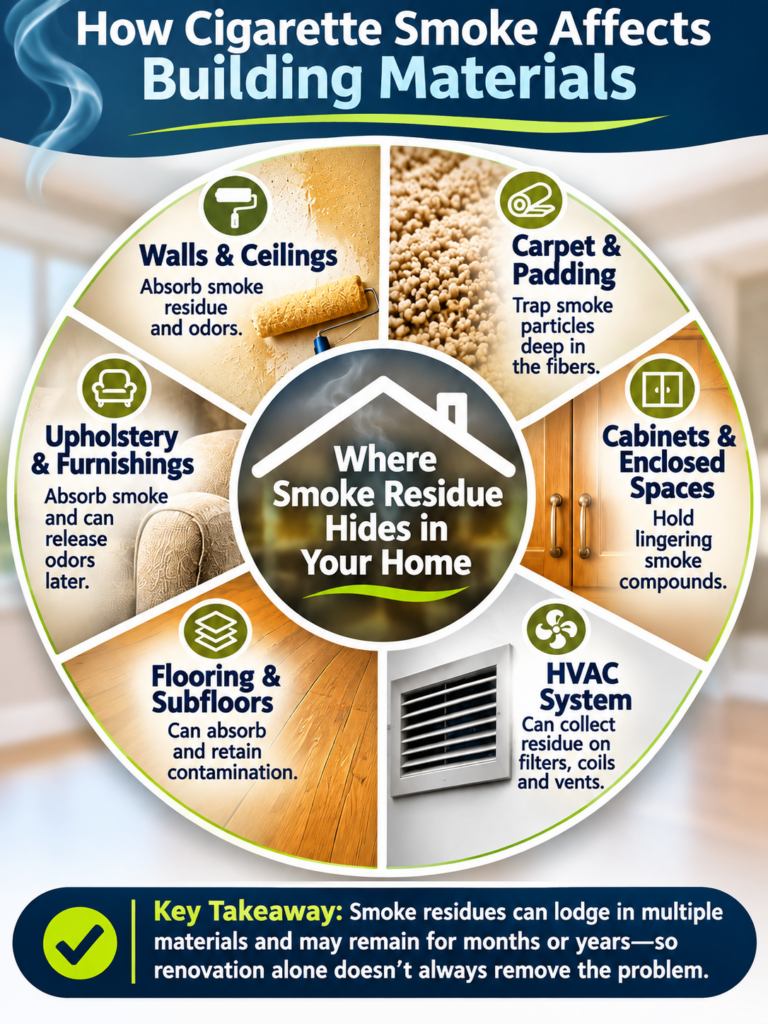
Smoke contamination does not behave identically across every material. Surface characteristics, porosity, exposure duration, and cleaning history influence how much residue accumulates and how difficult it becomes to remove.
Drywall, plaster, and painted surfaces
Walls and ceilings provide substantial surface area for tobacco smoke deposits.
Repeated exposure can create films containing nicotine and other smoke-related compounds. Some substances can also migrate into paint layers and underlying porous materials.
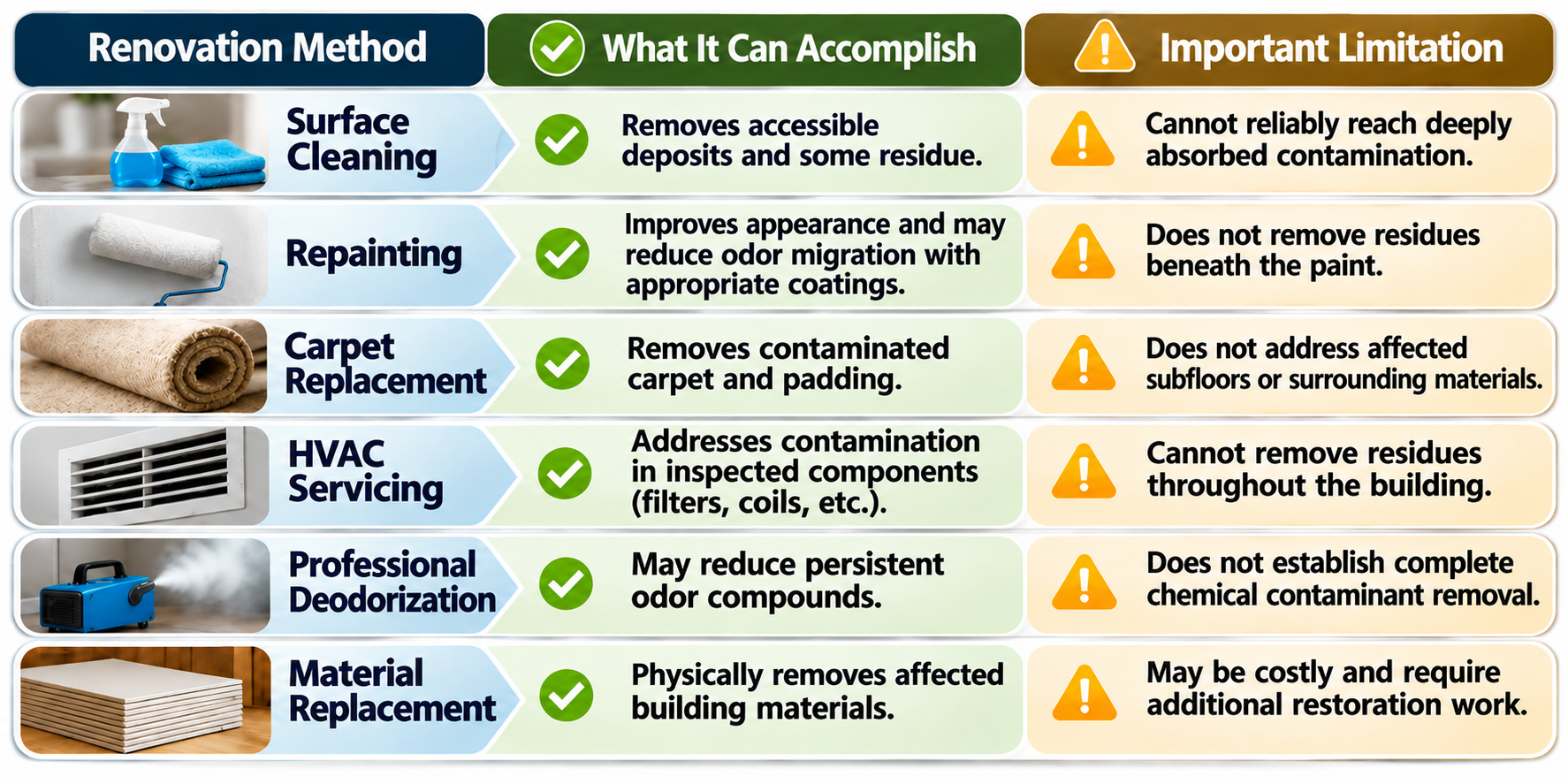
Cleaning may remove accessible surface deposits, but it cannot be assumed to remove contamination absorbed deeper into the substrate.
Carpeting, padding, and subfloors
Carpet fibers and padding can accumulate tobacco-related compounds over time.
Professional cleaning may improve conditions, but heavily contaminated padding may be more appropriately replaced.
Before installing new flooring, contractors should evaluate retained subfloor materials rather than assuming the removal of carpet resolves the entire problem.
Cabinets, unfinished wood, and enclosed spaces
Cabinet interiors, shelving, closets, and unfinished wood can retain residues that routine household cleaning does not reach.
These areas deserve particular attention when homeowners plan to preserve existing cabinetry during renovation.
HVAC components
Airborne contaminants can accumulate on HVAC filters and accessible system surfaces.
However, an odor that becomes noticeable when heating or cooling equipment operates does not automatically establish that ductwork is the primary source.
An assessment should consider the system's condition, contamination evidence, and other possible odor reservoirs.
For additional information, see Carolina Odor Pros' article The Hidden Connection Between Home Heating Systems and Persistent Household Odors.
What Common Renovation Methods Actually Accomplish
Renovation decisions should be based on the condition of affected materials rather than the assumption that a newly finished surface is necessarily free of contamination.
Why painting deserves particular attention
Painting is frequently one of the first improvements made before selling or occupying a home.
Specialty primers and sealants may reduce odor migration under appropriate conditions. However, sealing a contaminated surface is fundamentally different from removing the contaminants.
The 2026 scientific review notes that certain tobacco-related compounds may migrate through coatings over time.
This does not mean every painted wall requires demolition. It means the condition of the underlying material should be evaluated before selecting a restoration method.
Similarly, the EPA explains that ventilation, filtration, and air cleaning may reduce smoke-related exposure but cannot eliminate it entirely.
No single cosmetic renovation method should be treated as proof that thirdhand smoke contamination has been removed.
Renovation Planning: Why the Sequence Matters
For homeowners and renovation contractors, the most practical question is often not whether smoke odor can be reduced, but when remediation should occur.
Consider a property scheduled for new flooring, interior painting, and kitchen improvements.
If substantial tobacco contamination is discovered only after those improvements are completed, contractors may need to revisit recently finished areas.
A more efficient restoration sequence generally includes four stages.
1. Evaluate before demolition or refinishing
Document the property's smoking history when available. Inspect visible surfaces, retained furnishings, enclosed spaces, flooring, and relevant HVAC components.
Odor intensity can help identify areas for investigation, but it cannot reliably quantify chemical contamination.
2. Determine which materials can be restored
Not every affected material requires replacement.
Washable, nonporous surfaces may respond to appropriate cleaning. Porous materials with substantial contamination may require more extensive treatment or removal.
The decision should account for material condition, contamination severity, restoration objectives, and cost.
3. Complete cleaning and necessary removal before finishing
Address accessible contamination and remove materials selected for replacement before installing new finishes.
This reduces the likelihood of disturbing completed work.
4. Verify the outcome against the original objective
An odor assessment can help determine whether objectionable smells remain.
However, if the objective includes reducing chemical contamination, odor assessment alone is insufficient. Specialized sampling and laboratory analysis may be appropriate.
This distinction is particularly important when a property is being prepared for occupants concerned about residual tobacco exposure.
Does Professional Smoke Odor Remediation Replace Renovation?
Professional odor remediation and building renovation can complement one another, but they serve different purposes.
Odor treatment may help address persistent volatile compounds, while cleaning and material removal address contamination reservoirs.
Research also identifies limitations in oxidation-based treatments: reducing detectable odor does not necessarily demonstrate the removal of all potentially harmful substances.
A September 2026 review published in ACS ES&T Air further examined the persistence and chemical evolution of thirdhand smoke, reinforcing the importance of distinguishing odor control from comprehensive contamination assessment.
Review the scientific publication.
For properties with extensive historical smoking, the appropriate approach may combine targeted cleaning, selective replacement, professional deodorization, and verification when warranted.
The objective is not to prescribe the most extensive renovation possible. It is to select measures that address the property's documented conditions.
Frequently Asked Questions About Cigarette Smoke Contamination and Home Renovation
1. How can a homeowner determine whether cigarette smoke contamination is superficial or embedded in building materials?
Visual inspection and odor evaluation can identify potential problem areas, but neither can reliably determine how deeply tobacco-related compounds have penetrated a material.
A professional assessment should consider the property's smoking history, exposure duration, surface characteristics, previous cleaning, and the condition of porous materials. For example, a washable painted surface may respond differently from unfinished wood, carpet padding, or exposed drywall.
When objective evidence is necessary, laboratory analysis of surface nicotine samples can help document contamination. However, surface sampling does not necessarily establish the depth of contamination within a material.
The distinction matters because a treatment appropriate for surface deposits may be inadequate for residues embedded within a building substrate.
2. Can smoke contamination migrate from existing building materials into newly renovated areas?
Potentially, yes. Certain tobacco-related compounds can be released from contaminated materials into indoor air and subsequently deposit on other surfaces.
Research into thirdhand smoke has demonstrated that contaminated surfaces can act as reservoirs, releasing some compounds over time. Temperature, ventilation, humidity, and material characteristics may influence this process.
This is one reason renovation planning should consider retained materials rather than focusing exclusively on newly installed finishes.
However, the extent of transfer varies by property, and the presence of historical smoke contamination does not automatically mean every new surface will become significantly contaminated.
3. What should a homebuyer investigate when a property has been freshly painted but has a history of indoor smoking?
Fresh paint should be considered a cosmetic improvement unless there is documentation of additional remediation.
Buyers should ask what cleaning occurred before painting, whether specialty primers were applied, and whether contaminated carpeting, padding, or other materials were removed.
Closets, cabinet interiors, unfinished surfaces, and HVAC components may warrant additional inspection because these areas can be overlooked during cosmetic renovations.
Where substantial historical smoking is suspected, an independent assessment before closing can help buyers understand potential restoration expenses.
The objective is not to assume the property is unsuitable. It is to distinguish completed cosmetic work from documented contamination removal.
4. Can professional deodorization reduce cigarette smoke odor without removing every chemical residue?
Yes. Odor reduction and contaminant removal are related but distinct outcomes.
Professional deodorization may reduce compounds responsible for objectionable smells, but some tobacco-related substances may remain on or within building materials.
For example, oxidation-based treatments may alter certain odor-producing compounds without physically removing all deposited nicotine or other residues.
Homeowners should ask remediation providers what their treatment is designed to accomplish, which materials require prior cleaning or removal, and how treatment effectiveness will be evaluated.
A successful odor treatment should not automatically be interpreted as proof that every thirdhand smoke contaminant has been eliminated.
5. When does replacing contaminated building materials become more practical than attempting repeated treatments?
Material replacement becomes a stronger consideration when contamination is deeply embedded, the material cannot be adequately cleaned, or repeated treatment costs approach the expense of replacement.
Carpet padding, deteriorated porous materials, and heavily affected unfinished surfaces may present different restoration challenges from washable, nonporous surfaces.
Contractors should also consider accessibility and renovation timing. Removing a contaminated material before installing new flooring or cabinetry may be substantially less disruptive than addressing it afterward.
There is no universally established nicotine concentration that automatically requires demolition. Replacement decisions should be based on the material's condition, available treatment options, restoration objectives, and professional judgment.
6. What documentation should homeowners request after professional smoke odor remediation?
Homeowners should request a written description of the areas treated, methods used, materials removed or cleaned, and any limitations identified during the project.
If chemical treatment was performed, documentation should include relevant product information, application precautions, and reentry requirements.
Where the objective is odor reduction, a post-treatment inspection may help evaluate whether objectionable odors remain under normal building conditions.
If the objective includes demonstrating reduced chemical contamination, appropriate pre- and post-remediation sampling may be considered.
The most important distinction is that a completed odor treatment is not the same as laboratory verification that all thirdhand smoke residues have been removed.
Making Informed Restoration Decisions
A home with a history of indoor smoking is not automatically beyond restoration. Many affected properties can be improved through an appropriate combination of cleaning, renovation, and odor treatment.
The important distinction is understanding what each method can reasonably accomplish.
At Carolina Odor Pros, smoke odor remediation begins with evaluating the property and identifying affected areas. The company's professional smoke odor removal service describes a process involving inspection, specialized cleaning, aqueous chlorine dioxide treatment, and vapor-phase deodorization where appropriate.
Treatment methods must be selected for the specific property, with required occupancy and reentry precautions followed. Odor treatment should not be represented as laboratory-confirmed elimination of all thirdhand smoke residues.
For homebuyers, property owners, and renovation professionals in Charlotte, North Carolina, and surrounding communities, an assessment before major improvements can help clarify the work required.
Schedule a Smoke Odor Assessment
Before investing in extensive renovations, determine whether existing materials may be contributing to persistent cigarette smoke odors.
Carolina Odor Pros | Charlotte, NC