

Can Pet Odor Hurt Your Home Sale? What Buyers Notice First
Estimated Reading Time: 8 minutes
Can pet odor affect the sale of your home? Yes. Lingering pet odors can create negative first impressions, raise questions about hidden damage, and make buyers less confident about a property's condition. Although there is no universal dollar amount that pet odor subtracts from a home's value, addressing persistent smells before listing can help prevent avoidable objections during showings.
For homeowners preparing to sell in Charlotte, North Carolina, and surrounding communities, a fresh-smelling home isn't just a matter of cleanliness. It's part of presenting a property that buyers can feel comfortable purchasing.
Executive Brief
Pet ownership is common, but persistent pet odors can complicate a home sale. Buyers may interpret noticeable urine, dander, or animal-related smells as evidence of cleaning problems or possible damage beneath carpets and flooring. The most effective preparation involves identifying the source, evaluating affected materials, and correcting the problem before prospective buyers walk through the door.
Key Takeaways
- Pet odors can negatively influence buyer perceptions even when a home looks spotless.
- Homeowners often become accustomed to smells that visitors notice immediately.
- Pet urine may penetrate carpet padding, subfloors, and other porous materials.
- Air fresheners can mask odors temporarily without resolving their source.
- Professional odor assessment can help sellers determine whether cleaning, targeted treatment, or material replacement is appropriate.
1. What Do Buyers Notice First When Entering a Home?

A buyer's first impression begins the moment the front door opens.
Before examining the countertops, flooring, or freshly painted walls, visitors experience the home's overall atmosphere. That includes temperature, lighting, cleanliness, and smell.
In its March 2026 article, Your Home Listing Stinks! Here's What to Do About It, the National Association of REALTORS® identifies lingering odors as a significant concern during home showings.
Real estate professional Kimberly Schmidt summarizes the problem with a memorable industry expression:
"If I can smell it, I cannot sell it."
While not a literal rule for every transaction, the statement captures how strongly an unpleasant smell can interfere with a buyer's experience.
Pet-related odors may cause buyers to wonder:
- Has the animal repeatedly urinated indoors?
- Is the smell trapped beneath the carpeting?
- Will the odor remain after we move in?
- How much additional cleaning or flooring replacement might be necessary?
These concerns can distract from otherwise desirable features.
For sellers, the objective is not to conceal that pets lived in the home. It is to ensure lingering odors do not become the defining memory of the showing.
2. Why Homeowners Often Don't Notice Their Own Pet Odors
One of the greatest challenges in preparing a pet-friendly home for sale is olfactory adaptation, commonly called nose blindness.
When people experience the same odor repeatedly, their sensitivity to that smell can decrease. A homeowner who lives with dogs or cats may therefore perceive the home differently from someone entering it for the first time.
This explains why a seller might genuinely believe the house smells clean while a prospective buyer immediately detects pet odor.
The National Association of REALTORS® specifically discusses this problem in its guidance on unpleasant home-showing odors.
A practical pre-listing test: Ask a trusted friend, relative, or real estate agent who does not regularly visit your home to provide an independent assessment.
Have them check the entryway, bedrooms, pet sleeping areas, closets, and carpeted rooms.
Avoid using fragrances immediately before the visit. The goal is to understand how the property smells under ordinary conditions.
If an odor is noticeable, determine where it originates before attempting to cover it.
3. Can Pet Odors Actually Lower a Home's Selling Price?
Pet odors do not automatically reduce a property's appraised value, and there is no reliable nationwide percentage that applies to every home.
However, persistent odors can create conditions that complicate negotiations.
A buyer who suspects contamination beneath carpeting may request additional inspections, seek a cleaning allowance, negotiate repairs, or decide the property requires more work than anticipated.
The concern is often less about the presence of pets and more about the uncertainty surrounding the odor.
Research from the National Association of REALTORS® reinforces the importance of preparing homes with pets.
In its 2017 Animal House: Remodeling Impact report:
- 65% of REALTORS® reported always recommending cleaning a home to remove an animal's scent.
- 67% reported always recommending replacement of items damaged by animals.
- 41% reported always recommending professional home cleaning.
These findings reflect REALTOR® recommendations in that survey, not measured changes in selling prices.
The distinction matters: evidence supports odor removal as a common selling-preparation practice, but it does not establish a specific financial return.
For sellers, the practical question becomes: What will a buyer assume the odor means, and can that concern be resolved before the home is listed?
4. Why Pet Urine Odor Can Remain After Cleaning
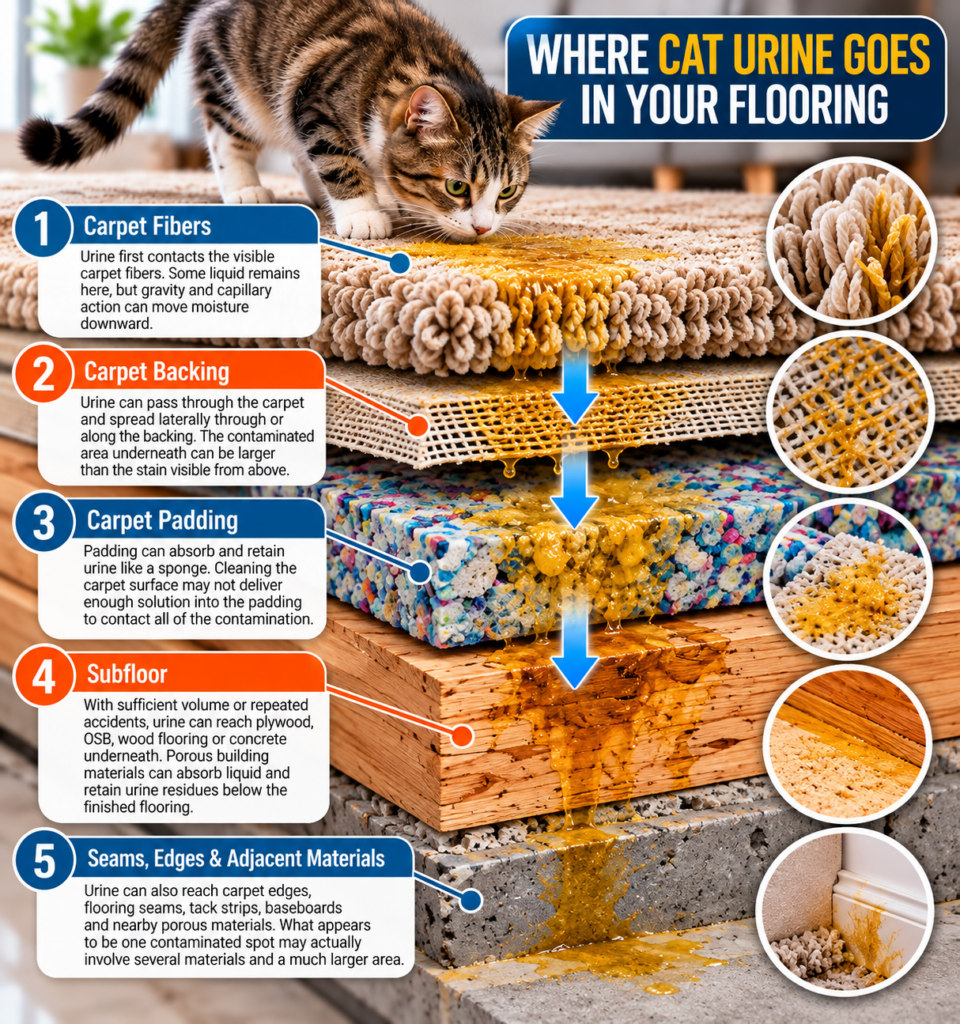
A home can appear exceptionally clean while still containing odor-producing residue.
Pet urine can penetrate multiple layers of flooring, particularly when accidents occur repeatedly in the same location.
Depending on the surface and amount of contamination, affected materials may include:
- Carpet fibers and backing
- Carpet padding
- Wood or engineered subflooring
- Baseboards and adjacent wall materials
- Upholstered furniture and rugs
Cleaning the visible surface may not reach all the contaminated material.
Carolina OdorPros explains this challenge in its article Pet Urine Odor Removal in the Carolinas, which discusses why odors can remain in carpet, padding, subfloors, and furniture long after cleaning.
Odor intensity can also change with humidity, temperature, and ventilation. This means a room that smells acceptable during one visit may smell noticeably different under other conditions.
The U.S. Environmental Protection Agency's indoor air quality guidance explains how ventilation, temperature, humidity, and indoor pollutant sources interact.
For homeowners preparing to sell, this creates an important distinction between a temporarily fresh-smelling room and one where the underlying odor source has been addressed.
5. Why Air Fresheners Aren't a Reliable Solution Before Showings
When a showing is approaching, scented candles, plug-in fragrances, and room sprays may seem like convenient solutions.
But covering one odor with another does not necessarily eliminate the original problem.
Strong fragrances may also make prospective buyers wonder whether something is being concealed.
The National Association of REALTORS® advises sellers to address the source of unpleasant smells rather than relying on competing fragrances.
There is also an indoor air quality consideration.
The EPA explains that certain air fresheners and fragranced cleaning products can contribute to indoor particulate matter and chemical reactions. This does not mean every fragrance is hazardous, but it does reinforce the value of avoiding unnecessary airborne products.
The better strategy is source control: locate the contamination, remove or treat affected materials appropriately, and use ventilation to support a comfortable indoor environment.
For persistent odors, professional evaluation can help determine whether the problem extends beyond routine housekeeping.
6. How to Prepare a Pet-Friendly Home Before Listing
The best time to address pet odor is before professional listing photographs, open houses, and scheduled showings.
A structured approach helps sellers avoid spending money on repeated cleaning methods that may not resolve the underlying issue.
Step 1: Evaluate the home as a first-time visitor. Enter after being away for several hours. Notice whether particular rooms, closets, or entryways have a distinct smell.
Step 2: Identify likely odor sources. Check pet bedding, litter box areas, carpeting, furniture, baseboards, and places where accidents previously occurred.
Step 3: Clean removable materials. Launder washable pet bedding, clean appropriate fabrics, and remove accumulated pet hair and debris.
Step 4: Assess flooring contamination. If urine odor remains after proper cleaning, determine whether padding or subflooring may be affected.
Step 5: Avoid masking persistent smells. Repeatedly applying deodorizing sprays may make it more difficult to judge whether the original odor remains.
Step 6: Consider professional odor assessment. When the source is unclear or the smell repeatedly returns, targeted evaluation can help identify the next appropriate step.
Step 7: Recheck before the first showing. Allow cleaned or treated areas to dry fully, ventilate appropriately, and request another independent odor assessment.
Homeowners facing particularly stubborn urine contamination may also benefit from Carolina OdorPros' guidance on professional pet odor removal.
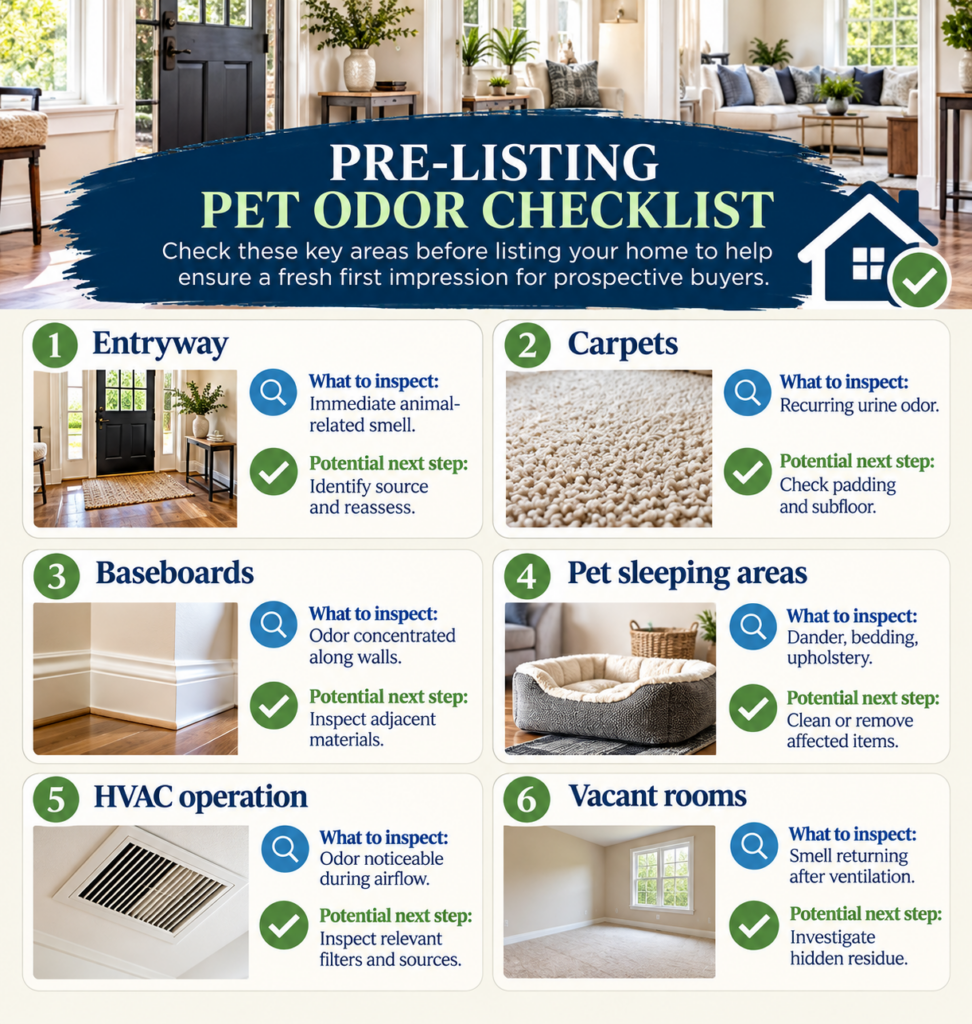 This checklist can help sellers prepare for showings without assuming every odor requires expensive replacement.
7. When Professional Pet Odor Removal Makes Sense
Not every pet odor problem requires professional remediation.
Routine animal smells may improve with appropriate cleaning, laundering, ventilation, and consistent pet care.
However, recurring urine odor, widespread contamination, or a smell that persists after thorough cleaning may indicate a deeper problem.
Carolina OdorPros describes its service approach on its Pet Odor Removal Services page:
"We start by identifying the sources of pet odors"
That source-first approach is especially relevant when a property is being prepared for sale.
Carolina OdorPros outlines a process involving inspection, targeted cleaning, deodorization, and air treatment where appropriate. Its website also describes the use of enzyme-based cleaning solutions to address organic odor sources.
The appropriate treatment depends on the affected materials, the extent of contamination, and the results of the assessment.
Some surfaces may be treatable. Severely affected padding or other materials may require replacement.
For homeowners, the benefit of professional evaluation is a clearer understanding of what needs attention before a buyer raises the same concerns.
Serving Charlotte and Surrounding Communities
Carolina OdorPros provides odor assessment and removal services throughout the Charlotte region, including Matthews, Ballantyne, Huntersville, Concord, Waxhaw, and nearby communities in North and South Carolina.
For real estate professionals, identifying persistent odors before listing can also help establish realistic preparation priorities with sellers.
A Fresh First Impression Begins Before the Showing
Selling a home involves more than presenting attractive photographs and well-maintained rooms.
Buyers need to feel comfortable imagining themselves living in the property.
Lingering pet odors can interrupt that experience, especially when they raise concerns about hidden contamination or future cleaning expenses.
Fortunately, a noticeable odor does not automatically mean an entire floor needs replacement or that a property cannot sell successfully.
The important step is identifying what is causing the smell and addressing the issue appropriately.
Don't Let Pet Odors Become a Buyer Objection
You've invested time and money preparing your home for sale. Don't let a lingering pet odor distract buyers from everything your property has to offer.
Carolina OdorPros helps Charlotte-area homeowners and real estate professionals identify and address persistent pet odors before showings begin.
Whether you're preparing to list your home or helping a client get their property market-ready, we're here to help.
Get Your Home Ready for Buyers — Contact Carolina OdorPros
Or call 855-600-3472.

Frequently Asked Questions About Pet Odors and Selling Your Home
1. Can a buyer negotiate a lower offer because of pet odors?
Yes. Buyers may use persistent pet odors as a reason to request a price reduction, cleaning allowance, or repairs, especially when they suspect urine contamination beneath carpeting. Whether those requests affect the final sale depends on the property's condition, local market, and negotiations.
2. Should I replace pet-stained carpeting before selling my house?
Not automatically. If contamination is limited to carpet fibers, professional cleaning may be sufficient. However, when urine has penetrated padding or subflooring, replacing the carpet alone may not eliminate the odor. Identifying the extent of contamination first can prevent unnecessary expenses.
3. Will a home inspection reveal hidden pet urine damage?
Not necessarily. Standard home inspections generally focus on visible and accessible conditions rather than specialized odor investigations. An inspector may identify staining or damaged materials, but contamination beneath flooring can remain undetected without additional evaluation.
4. Can pet odors return after professional cleaning?
Yes. If urine residue remains in carpet padding, subflooring, or other porous materials, odors may become noticeable again as temperature and humidity change. Effective treatment depends on identifying and addressing the affected materials rather than simply deodorizing the room.
5. Is it better to address pet odors before listing or offer buyers a cleaning credit?
Addressing the problem before listing is generally preferable because buyers experience the home's condition during their first showing. A cleaning credit may be negotiated, but it doesn't eliminate the uncertainty buyers feel about hidden contamination or future expenses.
6. How much does professional pet odor removal cost before selling a home?
Costs depend on the size of the affected area, the type of flooring, the extent of contamination, and whether materials require replacement. A professional assessment can help determine the appropriate treatment and avoid paying for unnecessary work.
7. Do sellers have to disclose previous pet urine damage to buyers in North Carolina?
North Carolina residential property disclosure requirements address specified property conditions, but they do not establish a universal requirement to disclose every past pet accident. Known damage or related material conditions may raise disclosure obligations depending on the circumstances. Sellers should consult their real estate agent or a qualified North Carolina real estate attorney rather than assume that cleaning or treatment eliminates disclosure responsibilities.